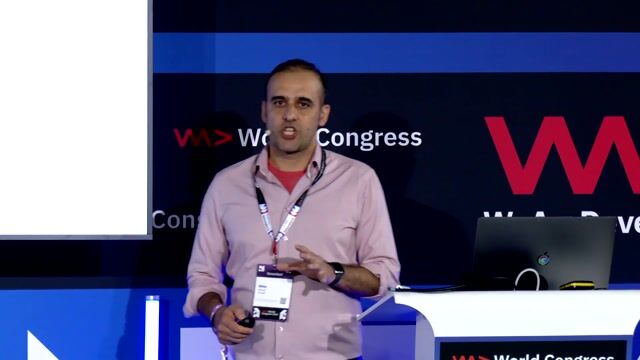
Mete Atamel
Lessons Learned Building a GenAI Powered App
#1about 2 minutes
The limitations of a static trivia database
The original quiz application was built on the Open Trivia API, which resulted in significant limitations like a fixed set of topics, formats, and languages.
#2about 5 minutes
Reimagining the quiz app with generative AI
A live demonstration showcases how generative AI can create dynamic quizzes on any topic, in any language, and even generate a relevant cover image.
#3about 6 minutes
The technical architecture of the GenAI quiz app
The application uses Flutter for the multi-platform UI, Cloud Run for hosting, Firestore for real-time data, and Vertex AI for accessing Google's generative models.
#4about 3 minutes
Navigating the inconsistency and uncertainty of LLMs
While GenAI makes complex tasks seem easy, achieving consistent and high-quality results is difficult due to the inherent non-deterministic nature of LLMs.
#5about 2 minutes
Knowing when not to use a large language model
For tasks like fuzzy string matching or simple image editing, traditional libraries and tools can be more effective, reliable, and cheaper than using an LLM.
#6about 4 minutes
Effective prompting and defensive coding for LLMs
Write clear but not overly detailed prompts, manage them like code with versioning, and code defensively to handle failures, malformed data, and empty results from the LLM.
#7about 2 minutes
Applying frameworks and engineering principles to LLM development
Using higher-level frameworks like LangChain can simplify development, while standard software engineering practices like caching and parallel calls are crucial for performance and cost management.
#8about 4 minutes
The challenge of ensuring quality and accuracy in LLMs
While it's easy to test the format of an LLM's output, verifying its quality and factual accuracy is much harder and may require using another LLM as a validator.
#9about 1 minute
Improving LLM accuracy with grounding techniques
To increase factual accuracy and reduce hallucinations, ground the model's responses in reliable data sources using tools like Google Search or a custom knowledge base via Vertex AI Search.
#10about 1 minute
How GenAI unblocks features but introduces new challenges
Generative AI can rapidly expand an application's capabilities, but this introduces a new class of problems related to accuracy, consistency, and validation that require new engineering solutions.
Related jobs
Jobs that call for the skills explored in this talk.


Wilken GmbH
Ulm, Germany
Senior
Amazon Web Services (AWS)
Kubernetes
+1

Matching moments
06:28 MIN
Building web apps and live experiences with AI Studio
Google Gemma and Open Source AI Models - Clement Farabet
05:32 MIN
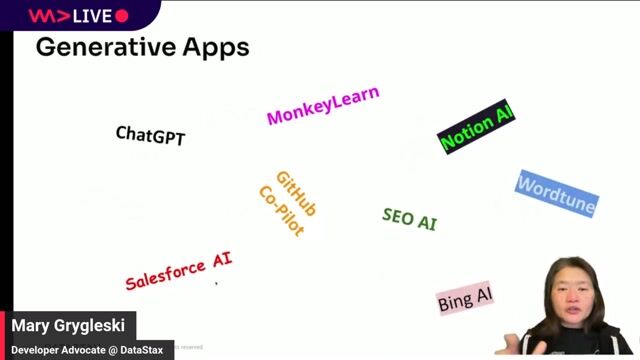
GenAI applications and emerging professional roles
Enter the Brave New World of GenAI with Vector Search
00:41 MIN
Key takeaways for building enterprise GenAI applications
Best practices: Building Enterprise Applications that leverage GenAI
06:17 MIN
Q&A on generative AI, company culture, and hybrid work
Unlocking the potential of Digital & IT at Vodafone

02:20 MIN
Overcoming the key challenges of building with GenAI
The State of GenAI & Machine Learning in 2025

04:28 MIN
Understanding the key challenges in operationalizing GenAI projects
From Traction to Production: Maturing your GenAIOps step by step
01:06 MIN
Moving beyond hype with real-world generative AI
Semantic AI: Why Embeddings Might Matter More Than LLMs
01:43 MIN
Key architectural challenges in building GenAI apps
Chatbots are going to destroy infrastructures and your cloud bills
Featured Partners
Related Videos
 25:17
25:17AI: Superhero or Supervillain? How and Why with Scott Hanselman
Scott Hanselman
 26:54
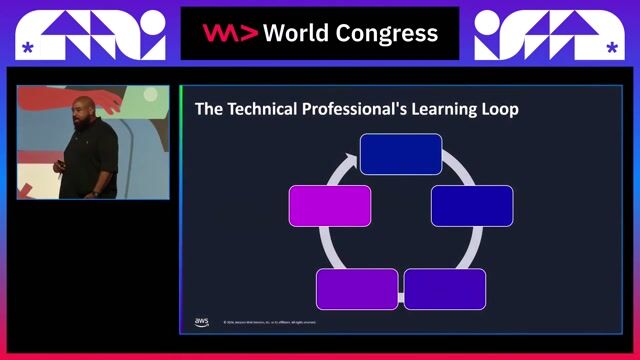
26:54Make it simple, using generative AI to accelerate learning
Duan Lightfoot
 24:33
24:33GenAI Security: Navigating the Unseen Iceberg
Maish Saidel-Keesing
 24:51
24:51Should we build Generative AI into our existing software?
Simon Müller
 38:19
38:19Exploring Google Gemini and Generative AI
 30:24
30:24ChatGPT: Create a Presentation!
Markus Walker
 32:26
32:26Bringing the power of AI to your application.
Krzysztof Cieślak
 32:13
32:13Supercharge your cloud-native applications with Generative AI
Cedric Clyburn
Related Articles
View all articles



From learning to earning
Jobs that call for the skills explored in this talk.


WeCloudData
Remote
Python
Machine Learning
Continuous Integration
Descripción De La Vacante
€80-110K
Intermediate
Python
Microservices
Mindrift
Remote
£41K
Junior
JSON
Python
Data analysis
+1
Missionat Humanoid
Charing Cross, United Kingdom
Remote
£80-90K
Intermediate
Python
PyTorch
Machine Learning
Amazon.com, Inc
Cambridge, United Kingdom
C++
Java
Python
Machine Learning