Maxim Salnikov
Privacy-first in-browser Generative AI web apps: offline-ready, future-proof, standards-based
#1about 3 minutes
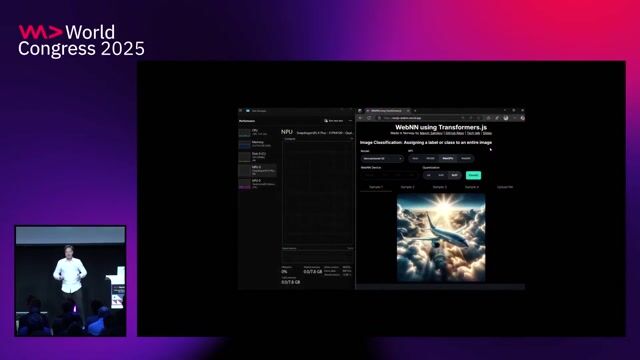
A demo of client-side AI using the NPU
A computer vision application performs image classification directly in the browser without any backend calls by leveraging the device's Neural Processing Unit (NPU).
#2about 3 minutes
The case for privacy-first, on-device AI
On-device AI meets user demands for performance, privacy, and offline access while satisfying developer needs for a unified codebase and helpful abstractions.
#3about 3 minutes
Introducing the Web Neural Network (WebNN) standard
The emerging WebNN standard provides a model-agnostic, unified abstraction for near-native AI execution in the browser, designed around practical use cases.
#4about 4 minutes
Leveraging hardware like the CPU, GPU, and NPU
WebNN can access all available hardware, with the NPU offering a power-efficient alternative to the GPU for sustained AI workloads on mobile devices.
#5about 6 minutes
Getting started with the low-level WebNN API
To experiment with the emerging WebNN standard, developers must use canary browser versions and enable specific flags, but its low-level API can be complex.
#6about 7 minutes
Simplifying development with high-level AI frameworks
Frameworks like ONNX Runtime Web and Transformers.js provide higher-level, task-based abstractions over WebNN, making it easier for app developers to build AI features.
#7about 3 minutes
Best practices and the future of browser AI
Focus on user experience by providing fallbacks and progress indicators, and look ahead to upcoming built-in browser APIs like the Prompt API that abstract away model management.
#8about 2 minutes
Demo code and using web workers for performance
The demo applications are built as offline-ready Progressive Web Apps and use Web Workers to run intensive AI computations without freezing the main UI thread.
Related jobs
Jobs that call for the skills explored in this talk.


Wilken GmbH
Ulm, Germany
Senior
Amazon Web Services (AWS)
Kubernetes
+1

Matching moments
01:55 MIN
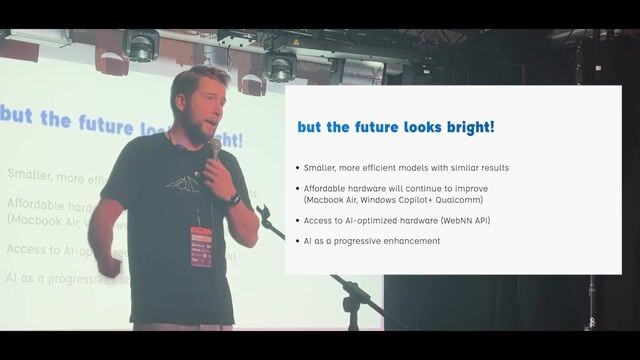
Key benefits of running AI in the browser
From ML to LLM: On-device AI in the Browser
02:20 MIN
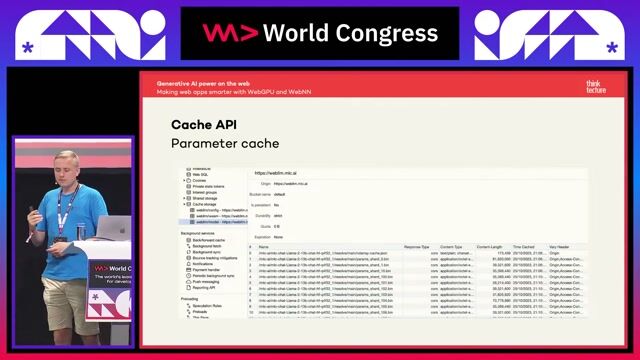
The technology behind in-browser AI execution
Generative AI power on the web: making web apps smarter with WebGPU and WebNN
11:35 MIN
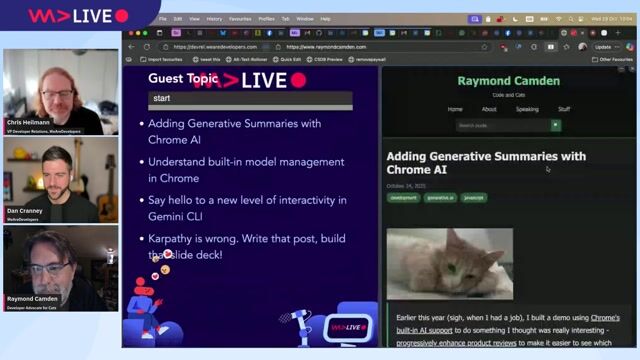
Implementing on-device AI with the Chrome AI API
WeAreDevelopers LIVE – AI vs the Web & AI in Browsers
01:41 MIN
Two primary approaches for browser-based AI
Prompt API & WebNN: The AI Revolution Right in Your Browser
01:14 MIN
The future of on-device AI in web development
Generative AI power on the web: making web apps smarter with WebGPU and WebNN
09:27 MIN
Performing inference in the browser with ONNX Runtime Web
Making neural networks portable with ONNX
01:29 MIN
Introduction to generative AI in the browser
Generate AI in the Browser with Chrome AI - Raymond Camden

02:08 MIN
The future of on-device AI hardware and APIs
From ML to LLM: On-device AI in the Browser
Featured Partners
Related Videos
 30:36
30:36Prompt API & WebNN: The AI Revolution Right in Your Browser
Christian Liebel
 32:27
32:27Generative AI power on the web: making web apps smarter with WebGPU and WebNN
Christian Liebel
 33:51
33:51Exploring the Future of Web AI with Google
Thomas Steiner
 27:23
27:23From ML to LLM: On-device AI in the Browser
Nico Martin
 25:47
25:47Performant Architecture for a Fast Gen AI User Experience
Nathaniel Okenwa
 36:41
36:41Generate AI in the Browser with Chrome AI - Raymond Camden
Raymond Camden
 35:16
35:16How AI Models Get Smarter
Ankit Patel
 53:46
53:46WeAreDevelopers LIVE – AI vs the Web & AI in Browsers
Chris Heilmann, Daniel Cranney & Raymond Camden
Related Articles
View all articles


From learning to earning
Jobs that call for the skills explored in this talk.


Missionat Humanoid
Charing Cross, United Kingdom
Remote
£80-90K
Intermediate
Python
PyTorch
Machine Learning
WeCloudData
Remote
Python
Machine Learning
Continuous Integration
Advanced Group
München, Germany
Remote
API
C++
Python
OpenGL
+6