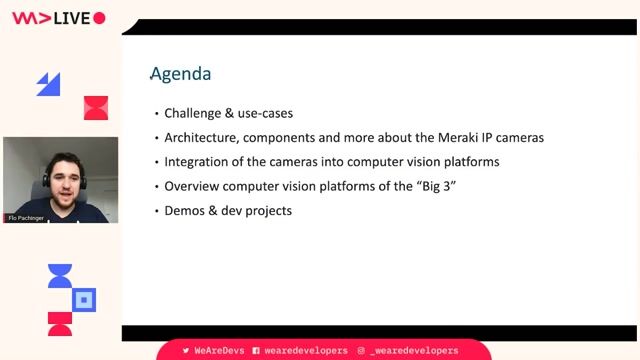
Flo Pachinger
Computer Vision from the Edge to the Cloud done easy
#1about 6 minutes
Defining computer vision and its real-world applications
Computer vision enables computers to understand digital images and videos, with applications in retail, public safety, traffic monitoring, and smart cities.
#2about 2 minutes
Understanding the key components of a vision system
A typical computer vision architecture includes cameras for recording, storage for footage, a machine learning pipeline for processing, and a dashboard for results.
#3about 3 minutes
Exploring the features of Cisco Meraki IP cameras
Cisco Meraki cameras are cloud-managed devices with on-board storage and processing for detecting people, vehicles, and audio events like fire alarms.
#4about 2 minutes
Integrating cameras using APIs, MQTT, and RTSP streams
Meraki cameras offer multiple integration points including a REST API, webhooks for cloud events, local MQTT for real-time triggers, and RTSP for video streaming.
#5about 6 minutes
Demoing real-time event detection and analysis
A live demonstration shows how a camera's local MQTT broker can trigger events for person detection in a zone and audio alarm recognition.
#6about 5 minutes
Designing an efficient event-driven vision architecture
Use on-camera analytics and MQTT triggers to send a single snapshot to a cloud vision API for analysis, reducing bandwidth and processing costs.
#7about 2 minutes
Comparing pre-trained models from AWS, Azure, and GCP
A comparison of the pre-trained computer vision models and pricing tiers available on AWS Rekognition, Azure Computer Vision, and Google Cloud Vision API.
#8about 1 minute
Deciding between pre-trained and custom vision models
While pre-trained models are easy to use, building a custom model with your own dataset is necessary for highly specific detection tasks.
#9about 3 minutes
Showcasing computer vision project examples
Practical examples demonstrate architectures for detecting face masks, capturing license plates, and using door sensors to trigger snapshots for analysis.
#10about 18 minutes
Answering audience questions on practical implementation
The Q&A session covers topics like using cameras for home security, filtering out pets from alerts, and the challenges of creating custom models for specific tasks.
Related jobs
Jobs that call for the skills explored in this talk.

Wilken GmbH
Ulm, Germany
Senior
Amazon Web Services (AWS)
Kubernetes
+1


zeb consulting
Frankfurt am Main, Germany
Remote
Junior
Intermediate
Senior
Amazon Web Services (AWS)
Cloud Architecture
+1
Matching moments
02:29 MIN
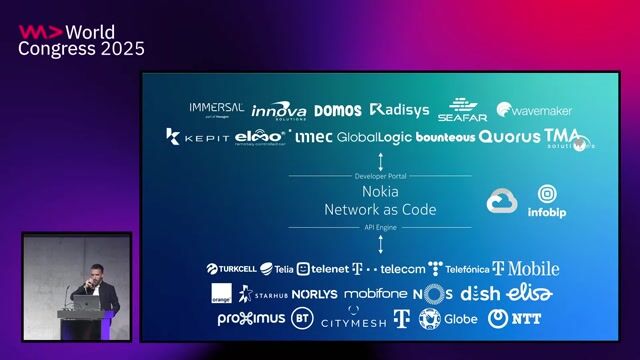
Exploring practical applications of network APIs
Code meets connectivity - Developers as the powerhouse of Network API innovation
00:48 MIN
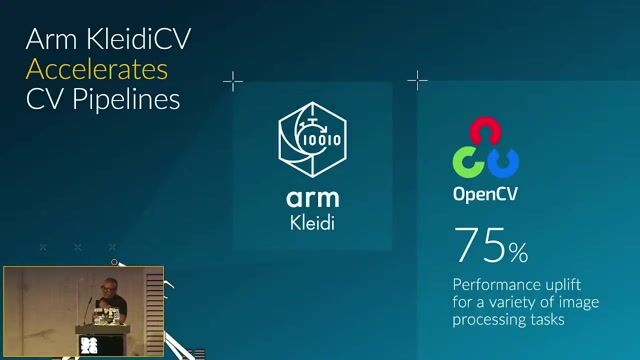
Enhancing computer vision pipelines with C-Cloudy CV
Unleashing the Full Potential of the Arm Architecture – Write Once, Deploy Anywhere
07:54 MIN
Connecting serverless compute with cloud storage
Functions Triggers using Azure Event Grids in Azure Blob Storage

21:29 MIN
A roundup of recent web development and tech news
WeAreDevelopers LIVE - Yes, CSS Can Do That!
25:09 MIN
Audience Q&A on serverless IoT development
Building your way to a serverless powered IOT Buzzwire game

06:44 MIN
The developer's journey for building AI applications
Supercharge your cloud-native applications with Generative AI
03:57 MIN
Building applications like intrusion and face detection
What comes after ChatGPT? Vector Databases - the Simple and powerful future of ML?

01:41 MIN
How the developer platform supports an AI ecosystem
Fireside Chat with Cloudflare's Chief Strategy Officer, Stephanie Cohen (with Mike Butcher MBE)
Featured Partners
Related Videos
 39:58
39:58Leverage Cloud Computing Benefits with Serverless Multi-Cloud ML
Linda Mohamed
 27:23
27:23From ML to LLM: On-device AI in the Browser
Nico Martin
 49:45
49:45Machine Learning for Software Developers (and Knitters)
Kris Howard
 28:51
28:51Detect Hand Pose with Vision
Milan Todorovic
 45:58
45:58Data Fabric in Action - How to enhance a Stock Trading App with ML and Data Virtualization
Andreas Christian
 57:52
57:52Develop AI-powered Applications with OpenAI Embeddings and Azure Search
Rainer Stropek
 48:54
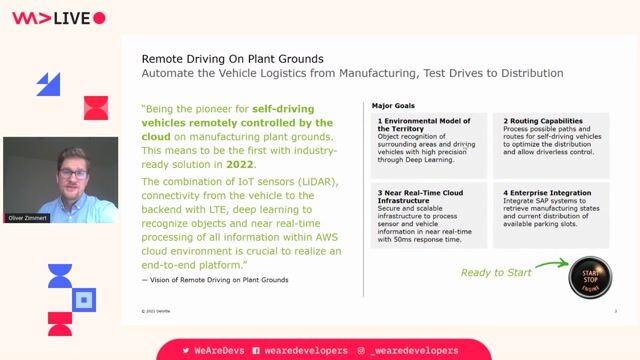
48:54Remote Driving on Plant Grounds with State-of-the-Art Cloud Technologies
Oliver Zimmert
 29:50
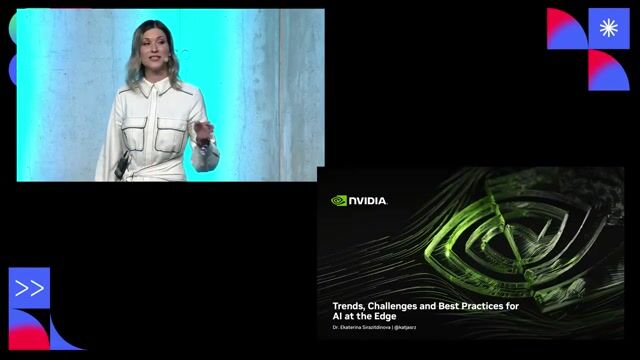
29:50Trends, Challenges and Best Practices for AI at the Edge
Ekaterina Sirazitdinova
Related Articles
View all articles



From learning to earning
Jobs that call for the skills explored in this talk.


PostNL
The Hague, Netherlands
Remote
€4-6K
Docker
Kubernetes
Computer Vision
+3
Power Reply GmbH & Co. KG
München, Germany
Azure
Data analysis
Computer Vision
Machine Learning
Amazon Web Services (AWS)
WeCloudData
Remote
Python
Machine Learning
Continuous Integration
AKDB Anstalt für kommunale Datenverarbeitung in Bayern
Köln, Germany
DevOps
Python
Docker
PyTorch
Grafana
+7
LinkiT
Amsterdam, Netherlands
Azure
DevOps
Python
PySpark
Terraform
+2
Paris-based
Paris, France
Python
Docker
TensorFlow
Kubernetes
Computer Vision
+2