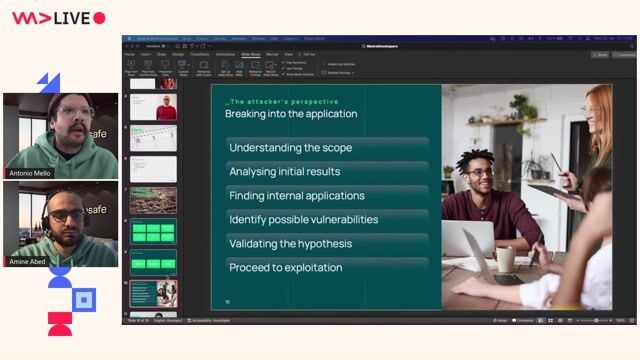
Antonio de Mello & Amine Abed
The attacker's footprint
#1about 10 minutes
Defining key cybersecurity tools and terminology
An overview of essential information security concepts and tools is provided, including nmap, Burp Suite, IDOR, LFI, and SIEM platforms.
#2about 16 minutes
Performing reconnaissance with an nmap port scan
The initial attack phase begins with an nmap scan to discover open ports and services, identifying potential web applications and an Apache server.
#3about 11 minutes
Gaining initial access with default credentials
After failed SQL injection attempts, access is gained by logging in with common default credentials and a path disclosure vulnerability is found via a malformed JSON.
#4about 13 minutes
Exploiting broken access control with cookie tampering
A base64-encoded cookie is manipulated to access another organization's data, and fuzzing reveals a hidden admin parameter to view sensitive information.
#5about 10 minutes
Reading sensitive files with a path traversal exploit
A known path traversal vulnerability in the Apache server is exploited to read the `/etc/passwd` file and a sensitive configuration file containing credentials.
#6about 1 minute
Achieving remote access via SSH with guessed credentials
Using the leaked username, the password from the configuration file is modified by incrementing the year to successfully log into the server via SSH.
#7about 21 minutes
Analyzing API logs to trace the attacker's steps
The defender analyzes API logs to identify failed SQL injection attempts, a successful login, parameter fuzzing, and cookie manipulation by observing response codes and body sizes.
#8about 15 minutes
Correlating web server and authentication logs
Apache and authentication logs are examined to find evidence of the nmap scan, the path traversal exploit, and the final successful SSH login after several failed attempts.
#9about 13 minutes
Demonstrating a SIEM for automated threat detection
A Security Information and Event Management (SIEM) tool is shown to automatically detect and flag suspicious activity, such as the nmap user agent, in real-time.
#10about 18 minutes
Summarizing vulnerabilities and key security recommendations
The workshop concludes with a summary of the attack chain and provides key recommendations for developers and defenders, such as patch management and maintaining high-quality logs.
Related jobs
Jobs that call for the skills explored in this talk.


IGEL Technology GmbH
Bremen, Germany
Senior
Java
IT Security
Matching moments

02:54 MIN
An overview of classic and modern injection attacks
How to Defend Against Data Manipulation Attacks - Bozidar Spirovski & Wekoslav Stefanovski
05:25 MIN
Applying security tools in test and delivery phases
Securing Your Web Application Pipeline From Intruders
04:38 MIN
Hands-on security training for developers
How GitHub secures open source

05:43 MIN
How attackers exploit developers and packages
Vue3 practical development
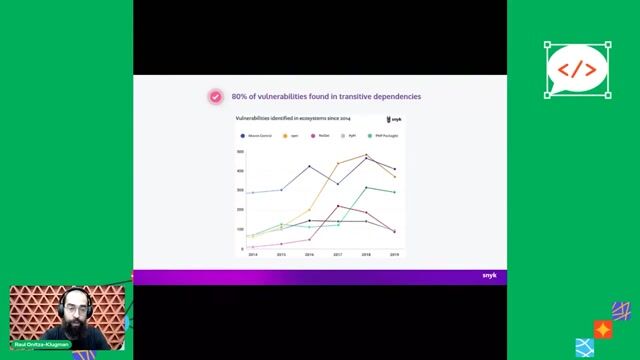
05:49 MIN
Common attacks targeting software developers
Vulnerable VS Code extensions are now at your front door

14:52 MIN
A practical demonstration of exploiting IDOR vulnerabilities
How to Cause (or Prevent) a Massive Data Breach- Secure Coding and IDOR
02:38 MIN
Examining high-impact path traversal exploits in the wild
Hack-Proof The Node.js runtime: The Mechanics and Defense of Path Traversal Attacks
11:24 MIN
Live hack: Recreating the Apache Struts vulnerability
Stranger Danger: Your Java Attack Surface Just Got Bigger
Featured Partners
Related Videos
 43:56
43:56Getting under the skin: The Social Engineering techniques
Mauro Verderosa
 40:38
40:38How to Cause (or Prevent) a Massive Data Breach- Secure Coding and IDOR
Anna Bacher
 29:34
29:34You can’t hack what you can’t see
Reto Kaeser
 44:30
44:30Securing Your Web Application Pipeline From Intruders
Milecia McGregor
 37:32
37:32Cyber Security: Small, and Large!
Martin Schmiedecker
 1:41:05
Maturity assessment for technicians or how I learned to love OWASP SAMM
Mathias Tausig
 57:47
57:47Cracking the Code: Decoding Anti-Bot Systems!
Fabien Vauchelles
 37:36
37:36Walking into the era of Supply Chain Risks
Vandana Verma
Related Articles
View all articles



From learning to earning
Jobs that call for the skills explored in this talk.


Digital Talent Agency
Municipality of Madrid, Spain
Intermediate
Python
Powershell
Network Security
Scripting (Bash/Python/Go/Ruby)
FERCHAU GmbH
NMap
Linux
Burp Suite
Metasploit
Network Security
Sólo para miembros registrados
€50-70K
Continuous Delivery
Continuous Integration
Amazon Web Services (AWS)
Infrastructure as Code (IaC)
Rapid7
Remote
Intermediate
aXite Security Tools
Amsterdam, Netherlands
Node.js
Angular
JavaScript
PSSWRD
Canton of Issy-les-Moulineaux, France
beaumont IT
Glasgow, United Kingdom
Remote
£45-65K
Azure
Google Cloud Platform
Amazon Web Services (AWS)
+1