Nils Hünerberg
Why make use of an integration platform in today's software developments and infrastructure?
#1about 3 minutes
The challenge of managing smart meter data at scale
Manual meter reading processes are inefficient and error-prone, while smart meters introduce new challenges for secure and accurate data transmission.
#2about 2 minutes
Defining application integration as a central hub
Application integration acts as a central hub to ensure seamless data flow and connectivity between disparate systems, applications, and databases.
#3about 2 minutes
Enhancing productivity, flexibility, and scalability
Integration platforms boost developer productivity with pre-built connectors and allow systems to scale based on business growth and data volume.
#4about 2 minutes
Achieving standardization, governance, and cost savings
Establishing common integration practices enforces security, compliance, and data validation, which accelerates time-to-market and reduces development costs.
#5about 2 minutes
Defining an integration platform and Eon's tech stack
An integration platform is a central hub for connecting systems and data, with Eon utilizing MuleSoft, Azure Integration Services, and AWS.
#6about 2 minutes
Evaluating platforms and designing with an API-led approach
Choose a platform by evaluating scalability, security, and ease of use, then design integrations using a three-layer API-led approach for reusability.
#7about 2 minutes
The four-step process for building integrations
A structured integration project begins with a rough concept to gather requirements, define necessary APIs, and map the high-level data flow.
#8about 1 minute
Creating a detailed design with a fine concept
The fine concept phase details the business logic, data transformations, and specific endpoints for each layer of the API-led architecture.
#9about 2 minutes
Implementation with RAML and the deployment lifecycle
The implementation phase uses RAML for API design and follows a four-environment lifecycle from development and testing to production deployment.
#10about 1 minute
Conclusion: Gaining a competitive edge with integration
Leveraging an integration platform enables organizations to build interconnected systems that respond faster to market demands and provide a competitive advantage.
Related jobs
Jobs that call for the skills explored in this talk.

Patronus Group
Berlin, Germany
Intermediate
Product Management
REST
+2

envelio
Köln, Germany
Remote
Senior
Python
Software Architecture

Wilken GmbH
Ulm, Germany
Senior
Amazon Web Services (AWS)
Kubernetes
+1
Matching moments

04:07 MIN
How data drives energy, security, and automation businesses
Unlocking Value from Data: The Key to Smarter Business Decisions-
04:46 MIN
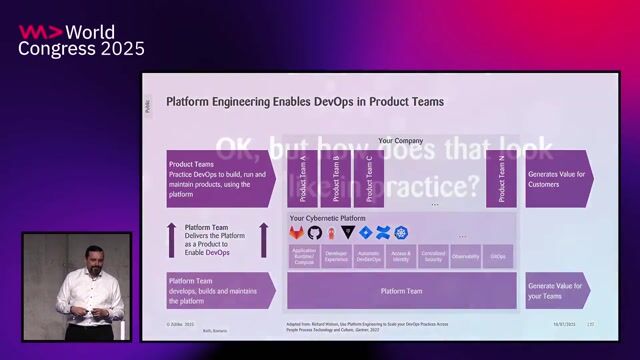
Using the floating platform pattern to integrate tools
AI-Augmented DevOps with Platform Engineering
02:14 MIN
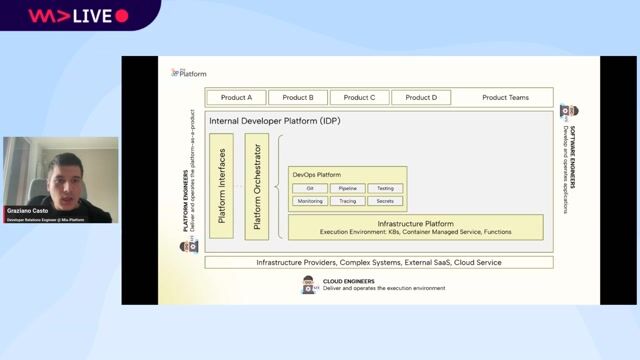
Expanding the platform vision with composability and data
Platform Engineering untold truths: is just an infrastructure matter?

01:13 MIN
Key takeaways for building a modern digital platform
Platform Engineering untold truths: is just an infrastructure matter?
06:47 MIN
Building a resilient and scalable API gateway
Improving Developer Happiness with GitOps
07:44 MIN
How business strategy drives the need for integration
Improving Developer Happiness with GitOps
02:08 MIN
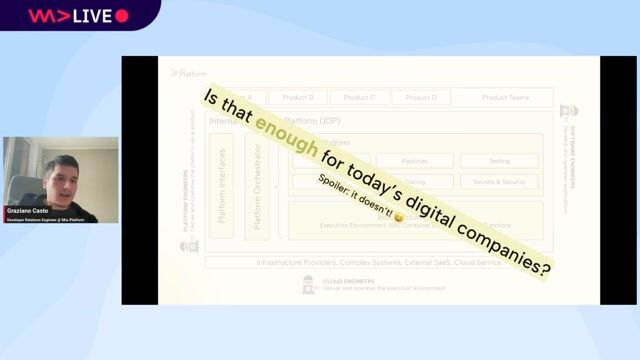
Moving beyond infrastructure to a marketplace-centric approach
Platform Engineering untold truths: is just an infrastructure matter?
01:47 MIN
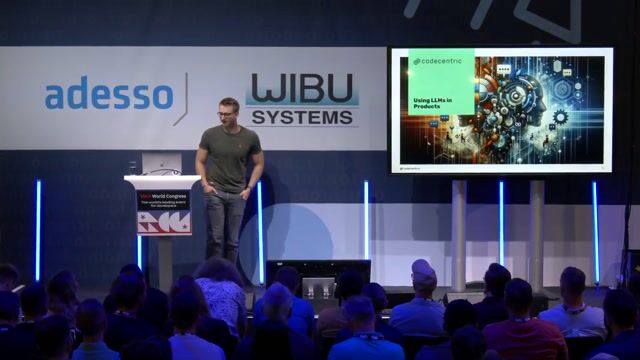
Three pillars for integrating LLMs in products
Using LLMs in your Product
Featured Partners
Related Videos
 29:31
29:31Introducing Green IT practices to a large Software Company
Pierre-Luc Noel & Fritz Reichmann
 24:13
24:13Strategies to accelerate SaaS Application Development
Rajalakshmi Srinivasan
 16:38
16:38Develop, test and run a communications application in a serverless cloud
Filippos Kyprianou & Maksym Mednikov
 58:40
58:40Platform Engineering vs. DevOps Why not both?
Christian Strack
 29:26
29:26Empowering Thousands of Developers: Our Journey to an Internal Developer Platform
Bastian Heilemann & Bruno Margula
 20:28
20:28Introducing a Digital Service Catalog for speed and scale
Bastian Heilemann & Akash Manjunath
 57:45
57:45Forget Developer Platforms, Think Developer Productivity!
Robert Hoffmann & Christian Denich
 28:29
28:29Unlocking Value from Data: The Key to Smarter Business Decisions-
Taqi Jaffri, Kapil Gupta & Farooq Sheikh and Tomislav Tipurić
Related Articles
View all articles



From learning to earning
Jobs that call for the skills explored in this talk.


ING
Amsterdam, Netherlands
Senior
Java
Solution Architecture
Business Process Management (BPM)


Siemens Healthineers
Erlangen, Germany
.NET
Kubernetes
Agile Methodologies
Continuous Delivery
Software Architecture
Siemens Healthineers
Erlangen, Germany
.NET
Continuous Delivery
Software Architecture
Nebius Group
Amsterdam, Netherlands
Intermediate
API
REST
Azure
Python
Terraform
+2
Siemens Energy
Erlangen, Germany
Scrum
Agile Methodologies