Arno Schödl
Why Iterators Got It All Wrong — and what we should use instead
#1about 1 minute
The dual role of C++ iterators as elements and borders
C++ iterators, modeled after pointers, are used ambiguously to represent both specific elements and the borders between them.
#2about 1 minute
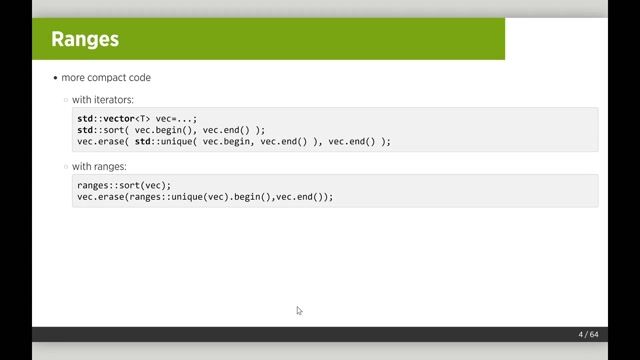
Writing cleaner code with C++ ranges
C++20 ranges simplify code by reducing the boilerplate of begin() and end() calls required with traditional iterator pairs.
#3about 4 minutes
Using range adapters for lazy transformations
Range adapters like transform allow for lazy evaluation, separating data projection from the search operation for more modular code.
#4about 2 minutes
How filter adapters create ambiguity for borders
The filter adapter demonstrates a flaw where mapping a border from a filtered range back to the original range is ambiguous.
#5about 5 minutes
The core problem with the reverse adapter
The reverse adapter proves that a single .base() method cannot correctly map both elements and borders back to the original range.
#6about 3 minutes
A formal solution with element and border concepts
The fundamental iterator flaw can be solved by introducing two distinct concepts: 'border' for positions between items and 'element' for the items themselves.
#7about 4 minutes
Improving algorithms with nullable elements and better names
Further improvements include making element types nullable to handle 'not found' cases cleanly and using more descriptive algorithm names like binary_find.
#8about 2 minutes
Conclusion and the think-cell range library
The think-cell C++ range library implements concepts like nullable elements and refined algorithms to address the inherent flaws in standard iterators.
#9about 4 minutes
Q&A on iterator invalidation and border types
The speaker addresses audience questions regarding how the border and element distinction interacts with container iterator invalidation and mathematical open or closed intervals.
Related jobs
Jobs that call for the skills explored in this talk.


Matching moments
08:00 MIN
Solving complex problems with advanced range adaptors
Functional Programming in C++

04:08 MIN
Building lazy data pipelines with C++20 ranges and views
Functional Programming in C++

07:25 MIN
Core design principles and the language evolution trilemma
The Design and Evolution of C++
06:50 MIN
C++ availability, ecosystem, and backwards compatibility
101 brilliant things of C++

04:19 MIN
Processing large datasets with the iterator pattern and streams
10 must-know design patterns for JS Devs

05:24 MIN
Debunking common myths about C++ in constrained systems
C++ in constrained environments

06:45 MIN
Writing reusable code with generic programming and templates
101 brilliant things of C++
07:50 MIN
Using modern language features for safer code
C++ in constrained environments
Featured Partners
Related Videos
 24:13
24:13C++ Features You Might Not Know
Jonathan Müller
 24:17
24:17The C++ rvalue lifetime disaster
Arno Schoedl
 45:27
45:27101 brilliant things of C++
Andreas Fertig
 1:00:16
C++ in constrained environments
Bjarne Stroustrup
 1:01:15
The Design and Evolution of C++
Bjarne Stroustrup
 28:07
28:07An (In-)Complete Guide to C++ Object Lifetimes
Jonathan Müller
 26:54
26:54Functional Programming in C++
Jonathan Müller
 27:27
27:27Things I learned while writing high-performance JavaScript applications
Michele Riva
Related Articles
View all articles



From learning to earning
Jobs that call for the skills explored in this talk.


&why GmbH
Berlin, Germany
€50-70K
Junior
Intermediate
Senior
React
Next.js
TypeScript


TheVentury FlexCo
Vienna, Austria
€47-51K
Intermediate
Senior
AI Frameworks
AI-assisted coding tools


Kittl
Berlin, Germany
Institut für Operations Research und Management GmbH
Intermediate
C++
GIT
Perl
Python
Gitlab
Trinamics
Utrecht, Netherlands
€3-6K
C++
Machine Learning