Phil Nash
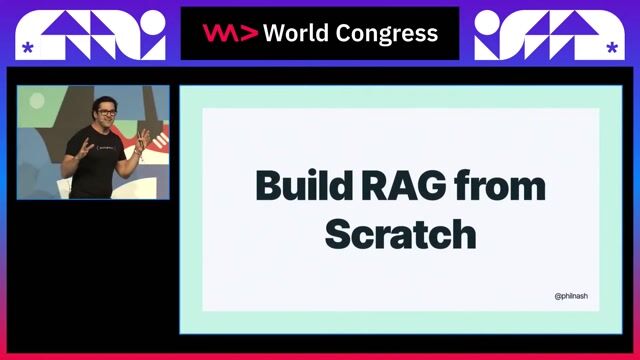
Build RAG from Scratch
#1about 3 minutes
Why large language models need retrieval augmented generation
Large language models have knowledge cutoffs and lack access to private data, a problem solved by providing relevant context at query time using RAG.
#2about 1 minute
How similarity search and vector embeddings power RAG
RAG relies on similarity search, not keyword search, which captures meaning by converting text into numerical representations called vector embeddings.
#3about 6 minutes
Building a simple bag-of-words vectorizer from scratch
A basic vector embedding can be created by tokenizing text, building a vocabulary of unique words, and representing each document as a vector of word counts.
#4about 8 minutes
Comparing document vectors using cosine similarity
Cosine similarity measures the angle between two vectors to determine their semantic closeness by focusing on direction (meaning) rather than magnitude.
#5about 3 minutes
Understanding the limitations of a bag-of-words model
The simple bag-of-words model is sensitive to vocabulary, slow to scale, and fails to capture nuanced semantic meaning like word order or synonyms.
#6about 4 minutes
Using professional embedding models and vector databases
Production RAG systems use sophisticated embedding models and specialized vector databases for efficient, accurate, and scalable similarity search.
#7about 2 minutes
Exploring advanced RAG techniques and other applications
Beyond basic similarity search, techniques like ColBERT and knowledge graphs can improve retrieval accuracy, and vector search can power features like related content recommendations.
Related jobs
Jobs that call for the skills explored in this talk.


Wilken GmbH
Ulm, Germany
Senior
Amazon Web Services (AWS)
Kubernetes
+1
Matching moments
03:45 MIN
Understanding retrieval-augmented generation systems
AI Model Management Life Circles: ML Ops For Generative AI Models From Research to Deployment
02:42 MIN
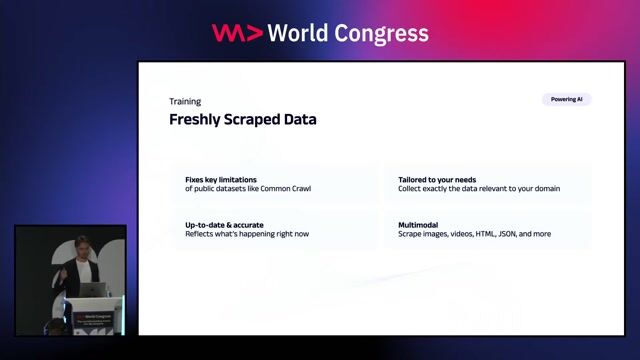
Powering real-time AI with retrieval augmented generation
Scrape, Train, Predict: The Lifecycle of Data for AI Applications
02:53 MIN
Understanding Retrieval-Augmented Generation (RAG)
Graphs and RAGs Everywhere... But What Are They? - Andreas Kollegger - Neo4j
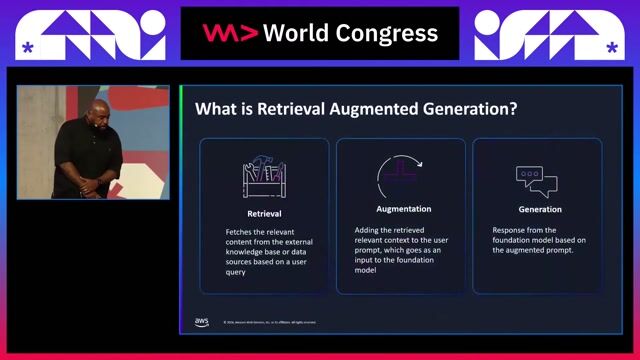
01:19 MIN
How retrieval-augmented generation (RAG) works
Make it simple, using generative AI to accelerate learning
05:31 MIN
Understanding retrieval-augmented generation (RAG)
Exploring LLMs across clouds
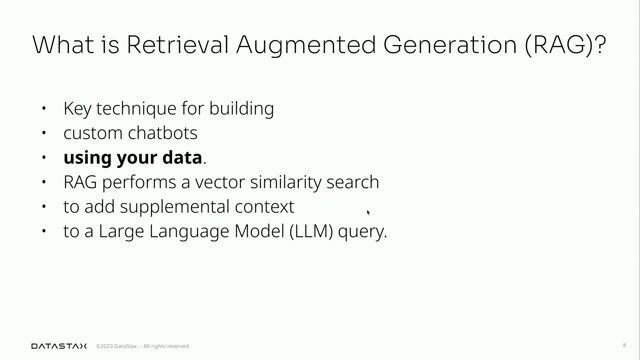
01:59 MIN
What is Retrieval Augmented Generation (RAG)?
Building Real-Time AI/ML Agents with Distributed Data using Apache Cassandra and Astra DB
01:49 MIN
Enhancing AI responses with retrieval augmented generation
Bringing the power of AI to your application.
04:10 MIN
A deep dive into retrieval-augmented generation
Lies, Damned Lies and Large Language Models
Featured Partners
Related Videos
 26:25
26:25Building Blocks of RAG: From Understanding to Implementation
Ashish Sharma
 21:17
21:17Carl Lapierre - Exploring Advanced Patterns in Retrieval-Augmented Generation
Carl Lapierre
 29:11
29:11Large Language Models ❤️ Knowledge Graphs
Michael Hunger
 26:54
26:54Make it simple, using generative AI to accelerate learning
Duan Lightfoot
 28:20
28:20Building Real-Time AI/ML Agents with Distributed Data using Apache Cassandra and Astra DB
Dieter Flick
 46:51
46:51Graphs and RAGs Everywhere... But What Are They? - Andreas Kollegger - Neo4j
 24:42
24:42Martin O'Hanlon - Make LLMs make sense with GraphRAG
Martin O'Hanlon
 31:12
31:12Using LLMs in your Product
Daniel Töws
Related Articles
View all articles


From learning to earning
Jobs that call for the skills explored in this talk.


The Rolewe
Charing Cross, United Kingdom
API
Python
Machine Learning
Riverty GmbH
Berlin, Germany
Java
Python
TypeScript
ARAG
Düsseldorf, Germany
Remote
Python
JavaScript
Agile Methodologies
Continuous Integration
Amazon.com, Inc
Cambridge, United Kingdom
C++
Java
Python
Machine Learning