
Paweł Łukaszuk
Tips, tricks and quirks in .NET
#1about 2 minutes
The surprising internal structure of generic lists
The generic `List<T>` in .NET is not a linked list but is implemented as a resizable array, which has important performance implications.
#2about 4 minutes
Comparing the performance of for and foreach loops
While `for` loops were historically faster, optimizations in .NET 7 have made `foreach` performance nearly identical due to reduced enumerator overhead.
#3about 4 minutes
Why `Where().Count()` is faster than `Count(predicate)`
Using `Count()` with a predicate is significantly slower than chaining `Where()` and `Count()` because it results in a virtual method call instead of an instance method call.
#4about 4 minutes
When not to use `StringBuilder` for concatenation
`StringBuilder` is not always the fastest option for joining strings; for a small number of short strings, simple concatenation with `+` can be more performant due to `StringBuilder`'s resizing overhead.
#5about 3 minutes
The difference between `string.Empty` and an empty literal
Despite generating different IL code, `string.Empty` and the `""` literal compile to identical assembly instructions and have the same performance, with the only difference being compile-time usage constraints.
#6about 5 minutes
Safer null checking and the risk of operator overloading
Using the `==` operator for null checks is unsafe because it can be overloaded; the `is null` pattern should be used instead to avoid unexpected behavior.
#7about 4 minutes
How to terminate an application instantly
The `Environment.FailFast` method immediately terminates an application without executing `catch` or `finally` blocks, making it a drastic way to handle catastrophic failures.
#8about 4 minutes
Understanding the default banker's rounding in .NET
The `Math.Round` method in .NET uses banker's rounding by default, which rounds values ending in .5 to the nearest even integer, a behavior that can be surprising.
Related jobs
Jobs that call for the skills explored in this talk.

Wilken GmbH
Ulm, Germany
Senior
Amazon Web Services (AWS)
Kubernetes
+1
Wilken GmbH
Ulm, Germany
Intermediate
Senior
JavaScript
Docker
+1

Matching moments
04:23 MIN
Q&A on performance, interfaces, and advanced learning
Where we're going we don't need JavaScript - Programming with Type Annotations

03:33 MIN
Q&A on performance, tooling, and alternatives
Discover .NET MAUI

01:57 MIN
Presenting live web scraping demos at a developer conference
Tech with Tim at WeAreDevelopers World Congress 2024
08:36 MIN
Practical developer tips for automation and presentation
WeAreDevelopers LIVE – AI vs the Web & AI in Browsers

07:45 MIN
Q&A on production code analysis and performance bottlenecks
Data Science on Software Data

16:37 MIN
Q&A on developer tooling and testing best practices
Data Mining Accessibility

02:35 MIN
Overview of modern C# community-loved features
Modern C#: A Dive into the Community's Most Loved new Features.

13:10 MIN
Q&A on Blazor development and the speaker's journey
Blazing Accessibility Basics
Featured Partners
Related Videos
 41:54
41:54Hacking C# from the inside - how to do anything in NET
Adam Furmanek
 57:23
57:23Exploring the Latest Features of .NET and C# by Building a Game
Rainer Stropek
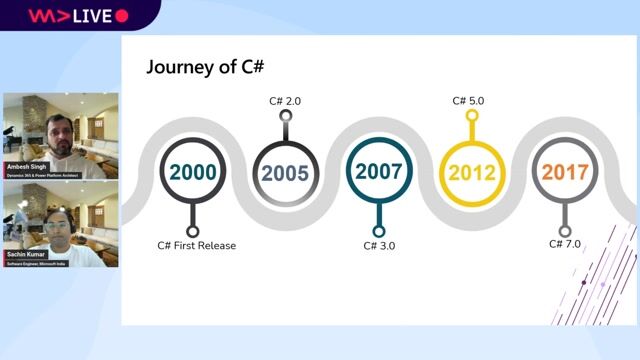 38:45
38:45C# 13 Unleashed: Live Demos of my Top 10 Cutting-Edge Features!
Ambesh Singh & Sachin Kumar
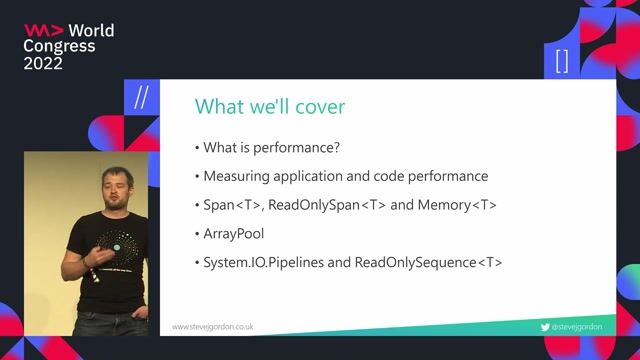 39:56
39:56Turbocharged: Writing High-Performance C# and .NET Code
Steve Gordon
 12:52
12:525 features that help you get the most out of C# 10
Louëlla Creemers
 30:55
30:55Why you must use TDD now!
Alex Banul
 26:34
26:34Asynchronicity and multithreading in C#
Grzegorz Lang
 41:21
41:21Building a Compiler with C#
Florian Rappl
Related Articles
View all articles



From learning to earning
Jobs that call for the skills explored in this talk.


Clerkenwell
Charing Cross, United Kingdom
API
.NET
Azure
Microservices
Continuous Integration
Kontext E
Kontext E
Dresden, Germany
Remote
.NET
ASP.NET
Microsoft SQL Server