Chris Heilmann
Catching up on the basics you don't really need that much code
#1about 2 minutes
Understanding the complexity of web performance
The world of web performance is vast and filled with confusing terms, but several key resources can help you get started.
#2about 1 minute
Connecting site speed to user happiness
Web performance is not just about metrics; slow and unresponsive interfaces directly impact user happiness and can make people feel frustrated.
#3about 2 minutes
Key resources for learning web performance
Get started with web performance by exploring courses from MDN and Google, understanding Core Web Vitals, and learning to use browser developer tools effectively.
#4about 3 minutes
Optimizing your site's hosting and HTML head
Improve performance by choosing a fast host, optimizing the order of elements in your HTML head tag, and implementing best practices like image optimization.
#5about 2 minutes
Understanding performance on diverse devices and networks
Performance is not just about your development machine; consider how slow devices, limited CPU/GPU, and network latency impact the user experience.
#6about 1 minute
Adapting to device load with the Compute Pressure API
The upcoming Compute Pressure API will allow websites to adapt dynamically by detecting when a user's machine is under heavy load and adjusting content accordingly.
#7about 3 minutes
Bet on the platform and write less code
Improve performance by trusting the browser and using native HTML features over heavy JavaScript, and remember that the best performing code is often the code you never write.
Related jobs
Jobs that call for the skills explored in this talk.


Hubert Burda Media
München, Germany
€80-95K
Intermediate
Senior
JavaScript
Node.js
+1

Matching moments
06:10 MIN
The ongoing debate for JavaScript-free web solutions
WeAreDevelopers LIVE – Keeping Up with Styles, Data & More
03:18 MIN
Relying on native browser features and the platform
The Lean Web

02:33 MIN
Why you might not need JavaScript for everything
WeAreDevelopers LIVE – You Don’t Need JavaScript, Modern CSS and More
02:16 MIN
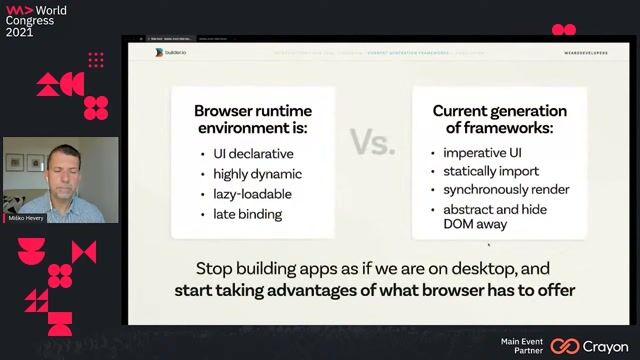
Rethinking web development by embracing the DOM
Rethinking web application design for fastest possible time to interactive
02:44 MIN
The performance problem with modern web applications
Qwik: Making sure that easy is same as performant

05:04 MIN
Overcoming the developer habit of reaching for JavaScript
NoLoJS - Avoiding JavaScript Cruft with HTML and CSS - Aaron T. Grogg

11:10 MIN
The only frontend stack that truly matters
WeAreDevelopers LIVE – Frontend Inspirations, Web Standards and more
04:59 MIN
The philosophy behind the NoLoJS project
NoLoJS - Avoiding JavaScript Cruft with HTML and CSS - Aaron T. Grogg
Featured Partners
Related Videos
 40:24
40:24Snappy UI needs no Single-Page Application
Clemens Helm
 1:15:44
Using all the HTML, Running State of the Browser and "Modern" is Rubbish
Chris Heilmann & Daniel Cranney and David Letorey
 51:10
51:10Web development best practices in 2021
Laurie Voss
 46:39
46:39Frameworkless: How to use Web-Components in production?
Tobias Münch
 42:46
42:46The Naked Web Developer: Your Browser Is Your Framework
Avichay Eyal
 46:46
46:46The Lean Web
Chris Ferdinandi
 44:43
44:43Explore new web features before everyone else
Nikita Dubko
 43:08
43:08A journey of a long list in React
Adam Klein
Related Articles
View all articles



From learning to earning
Jobs that call for the skills explored in this talk.


&why GmbH
Berlin, Germany
€50-70K
Junior
Intermediate
Senior
React
Next.js
TypeScript


Cambridge Intelligence
Cambridge, United Kingdom
React
DevOps
Node.js
WebPack
JavaScript
+1
O&O Software GmbH
Ansfelden, Austria
€43K
CSS
WebGL
React
jQuery
+2