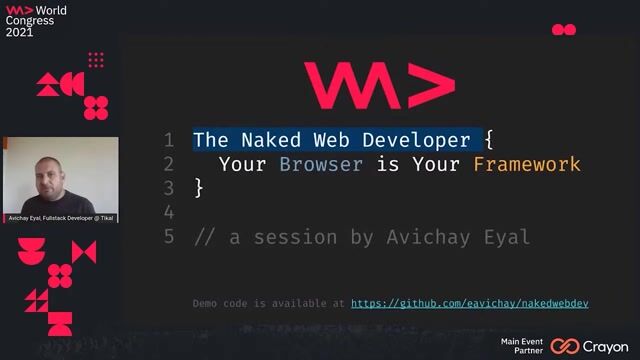
Avichay Eyal
The Naked Web Developer: Your Browser Is Your Framework
#1about 5 minutes
The case for framework-free web development
Frameworks provide a safety net but come with bloat and integration challenges, prompting an exploration of building applications using only browser APIs.
#2about 3 minutes
Implementing a pub/sub system with native browser events
Create a lightweight event bus for application-wide messaging by wrapping the browser's built-in EventTarget API instead of using a library.
#3about 4 minutes
Creating observable state with JavaScript proxies
Use JavaScript Proxy objects to trap property assignments on a state object, automatically dispatching events on change for reactive state management.
#4about 5 minutes
Achieving dependency injection with class mixins
Implement a dependency injection pattern by creating class mixins that extend a base class and inject required services at runtime during object construction.
#5about 2 minutes
Using native web components for component authoring
Leverage native Web Components as a standard, framework-agnostic way to create encapsulated and reusable UI elements without third-party dependencies.
#6about 4 minutes
Creating a client-side router with the popstate event
Build a simple client-side router by listening for the popstate event, parsing the URL, and dynamically loading the correct component into a designated outlet element.
#7about 4 minutes
Passing environment variables using HTML meta tags
Inject environment variables into a client-side application without a build process by storing them in data-* attributes on a meta tag and reading them via the dataset API.
#8about 2 minutes
Evaluating the pros and cons of going framework-free
Weigh the trade-offs of avoiding frameworks, balancing the cons like initial setup time against the pros of performance, flexibility, and deeper team expertise.
#9about 14 minutes
Q&A on security, browser support, and testing
The discussion addresses common concerns about framework-free development, including security best practices, handling legacy browsers, and applying standard testing methodologies.
Related jobs
Jobs that call for the skills explored in this talk.

Hubert Burda Media
München, Germany
€80-95K
Intermediate
Senior
JavaScript
Node.js
+1

Matching moments
06:10 MIN
The ongoing debate for JavaScript-free web solutions
WeAreDevelopers LIVE – Keeping Up with Styles, Data & More
03:04 MIN
Why you should consider frameworkless web components
Frameworkless: How to use Web-Components in production?
02:16 MIN
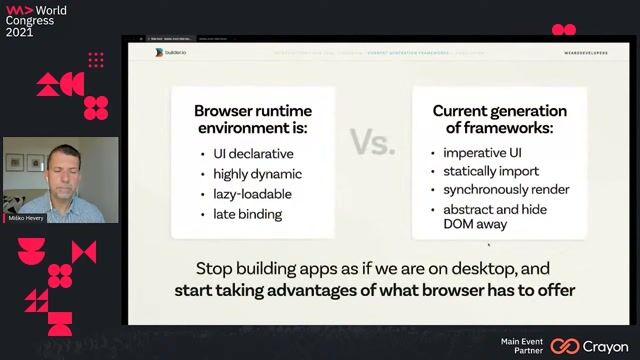
Rethinking web development by embracing the DOM
Rethinking web application design for fastest possible time to interactive
02:01 MIN
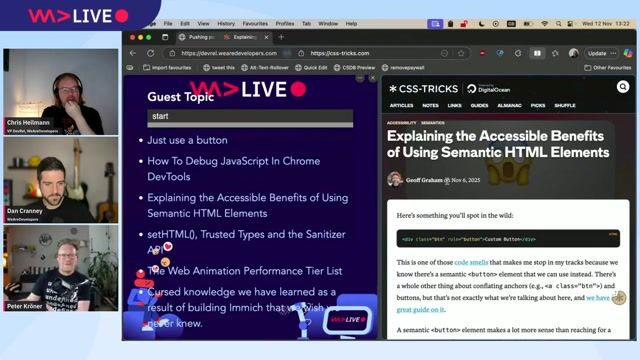
The difficulty of advocating for web standards in a framework world
WeAreDevelopers LIVE – Spicy Vanilla Web, CSS Magic & More
11:32 MIN
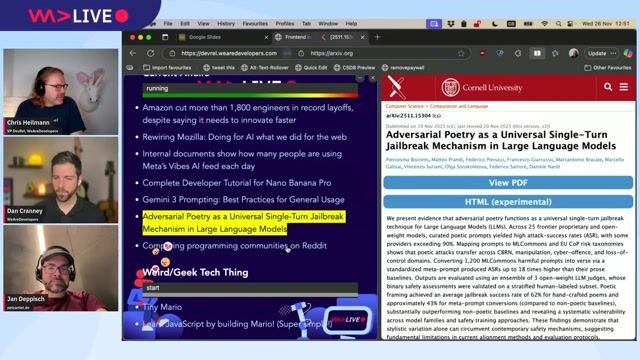
The industry's focus on frameworks over web fundamentals
WeAreDevelopers LIVE – Frontend Inspirations, Web Standards and more
02:23 MIN
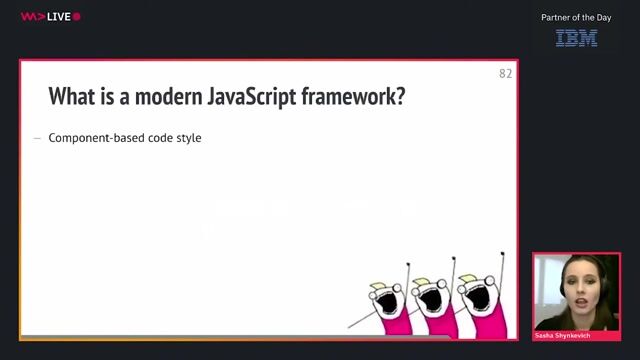
What to expect from any modern framework
How to Stop Choosing JavaScript Frameworks and Start Living

12:29 MIN
Navigating JavaScript fatigue and framework evolution
WeAreDevelopers LIVE - Whats Nuxt and Next for app development, 20 years AJAX and more
02:07 MIN
Why native browser APIs are replacing third-party libraries
Web APIs you might not know about
Featured Partners
Related Videos
 14:44
14:44Catching up on the basics you don't really need that much code
Chris Heilmann
 46:39
46:39Frameworkless: How to use Web-Components in production?
Tobias Münch
 46:46
46:46The Lean Web
Chris Ferdinandi
 41:54
41:54Extending HTML with Web Components
Rowdy Rabouw
 40:24
40:24Snappy UI needs no Single-Page Application
Clemens Helm
 32:56
32:56Web development: where are we, and where are we going?
Laurie Voss
 43:11
43:11The State Of The Web
Jeremy Keith
 44:43
44:43Explore new web features before everyone else
Nikita Dubko
Related Articles
View all articles



From learning to earning
Jobs that call for the skills explored in this talk.


&why GmbH
Berlin, Germany
€50-70K
Junior
Intermediate
Senior
React
Next.js
TypeScript