
Tobias Münch
Frameworkless: How to use Web-Components in production?
#1about 3 minutes
Why you should consider frameworkless web components
Web components offer a solution to dependency chain risks, performance overhead, and maintainability issues by relying on native browser standards instead of external frameworks.
#2about 5 minutes
Understanding the core standards of web components
The foundation of web components consists of key standards like the Shadow DOM for encapsulation, Custom Elements for defining new HTML tags, and HTML Templates with Slots for reusable markup.
#3about 3 minutes
Managing the web component lifecycle and attributes
Web components follow a defined lifecycle with callbacks like connectedCallback and disconnectedCallback, while attributeChangedCallback responds to changes in observed attributes.
#4about 3 minutes
Choosing rendering strategies and passing data
Components can be rendered by directly manipulating the DOM, re-rendering entirely, or using a virtual DOM approach, and complex data can be passed as object properties.
#5about 4 minutes
Structuring a production project with web components
A production application was structured using a domain-driven design approach, leading to the creation of a custom base component library to improve development pace.
#6about 1 minute
Using web components to migrate legacy applications
Web components can be used to incrementally modernize legacy applications by replacing old components one by one without a full rewrite.
#7about 1 minute
Weighing the advantages and disadvantages of web components
While web components offer high performance and no dependencies, they come with a steeper learning curve, slower initial development pace, and the responsibility of maintaining your own code library.
#8about 17 minutes
Live coding an editable list with web components
A practical demonstration shows how to build an interactive list component from scratch, covering rendering, state management, event handling, and component interaction.
#9about 2 minutes
Conclusion and when to use lightweight frameworks
While pure web components offer long-term stability, lightweight frameworks like Stencil.js or Slim.js can provide a practical compromise for faster development and added comfort.
#10about 8 minutes
Answering audience questions about web components
The Q&A session addresses topics like Internet Explorer compatibility, the role of frameworks like Stencil, bundle size concerns, and the strategic trade-offs of going frameworkless.
Related jobs
Jobs that call for the skills explored in this talk.


Hubert Burda Media
München, Germany
€80-95K
Intermediate
Senior
JavaScript
Node.js
+1
Matching moments
07:10 MIN
Understanding web components and their core technologies
Accessibility with Web Components
04:47 MIN
Using web components to abstract framework details
Advanced Micro Frontends: Multi-Version and Multi-Framework Scenarios
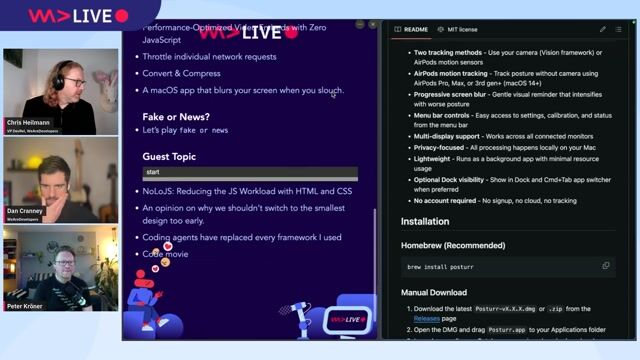
06:10 MIN
The ongoing debate for JavaScript-free web solutions
WeAreDevelopers LIVE – Keeping Up with Styles, Data & More

03:17 MIN
Understanding the role and value of web components
Keith Cirkle of GitHub on React Fatigue
02:16 MIN
Using Web Components and Svelte as an alternative
On tour with heroes == Moving from Angular to WebComponents
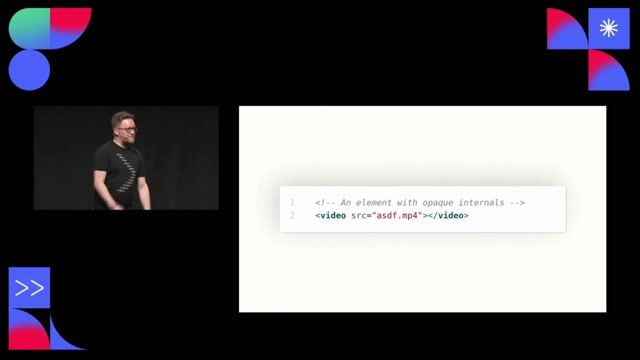
03:33 MIN
Creating modern code islands with web components
Defeat that legacy monster! Guerilla refactoring with web standards
01:12 MIN
Introducing the three core parts of web components
Extending HTML with Web Components
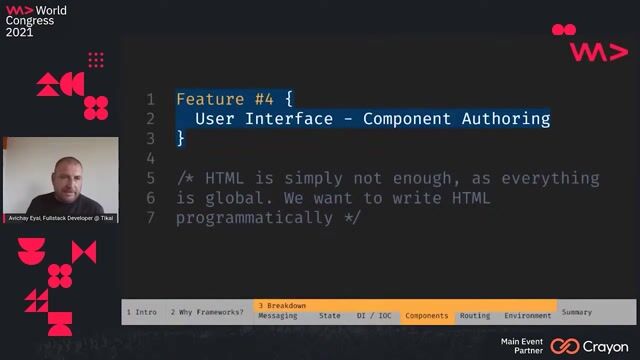
01:37 MIN
Using native web components for component authoring
The Naked Web Developer: Your Browser Is Your Framework
Featured Partners
Related Videos
 41:54
41:54Extending HTML with Web Components
Rowdy Rabouw
 44:43
44:43Explore new web features before everyone else
Nikita Dubko
 14:44
14:44Catching up on the basics you don't really need that much code
Chris Heilmann
 42:46
42:46The Naked Web Developer: Your Browser Is Your Framework
Avichay Eyal
 43:08
43:08On tour with heroes == Moving from Angular to WebComponents
Benjamin Glusa
 45:40
45:40Micro Frontends with Module Federation: Why and How?
Manfred Steyer
 41:28
41:28Component styling in a JS world — evolve your mental model
Maximilian Heinrich
 46:46
46:46The Lean Web
Chris Ferdinandi
Related Articles
View all articles



From learning to earning
Jobs that call for the skills explored in this talk.


&why GmbH
Berlin, Germany
€50-70K
Junior
Intermediate
Senior
React
Next.js
TypeScript


BPCS Consulting Services GmbH
München, Germany
€70-85K
Intermediate
React
Vue.js
TypeScript


freenet DLS GmbH
Büdelsdorf, Germany
Intermediate
Node.js
Angular
TypeScript


PiNCAMP GmbH
Berlin, Germany
Senior
React
GraphQL
Next.js


CONCEPTNET GmbH
Regensburg, Germany
Junior
CSS
HTML
JavaScript
O&O Software GmbH
Ansfelden, Austria
€43K
CSS
WebGL
React
jQuery
+2
Weidmüller GmbH & Co KG
Marktheidenfeld, Germany
Go
API
C++
Scrum
DevOps
+4