Eliran Natan
Build UIs that learn - Discover the powerful combination of UI and AI
#1about 1 minute
The performance problem of large single-page applications
Large component codebases in single-page applications can lead to significant loading delays and a poor user experience.
#2about 3 minutes
Using lazy loading and prefetching to improve performance
React's lazy loading API defers component loading, and dynamic imports can prefetch resources before they are explicitly requested by the user.
#3about 3 minutes
Predicting user actions with machine learning sequences
User navigation can be modeled as a sequence prediction problem, where a machine learning model predicts the next click based on past behavior.
#4about 2 minutes
Designing a neural network for click prediction
An LSTM (Long Short-Term Memory) neural network is well-suited for sequence prediction, using one-hot encoding to represent user actions without false correlations.
#5about 1 minute
Implementing the prediction model with TensorFlow.js
TensorFlow.js allows for building and running machine learning models directly in the browser using a sequential API to stack network layers.
#6about 1 minute
Training the model asynchronously with user data
The model is trained asynchronously in the background using the `fit` command, allowing the application to adapt to user behavior over time without blocking the UI.
#7about 3 minutes
Architecting a solution with the React Context API
A centralized architecture using two React contexts, one for prediction logic and one for prefetching, decouples the prediction source from the prefetching action.
#8about 3 minutes
Implementing the context-based prefetching logic in code
A custom `PredictionLink` component uses the `useContext` hook to listen for predictions and trigger prefetching via the prefetch context.
#9about 3 minutes
Summary of the intelligent prefetching technique
Combining React's code splitting with a browser-based machine learning predictor creates a powerful system for improving application performance by prefetching resources.
Related jobs
Jobs that call for the skills explored in this talk.


Hubert Burda Media
München, Germany
€80-95K
Intermediate
Senior
JavaScript
Node.js
+1
Matching moments
02:43 MIN
Implementing code splitting and lazy loading for faster initial loads
How Your Bundle Size Affects The Climate
01:24 MIN
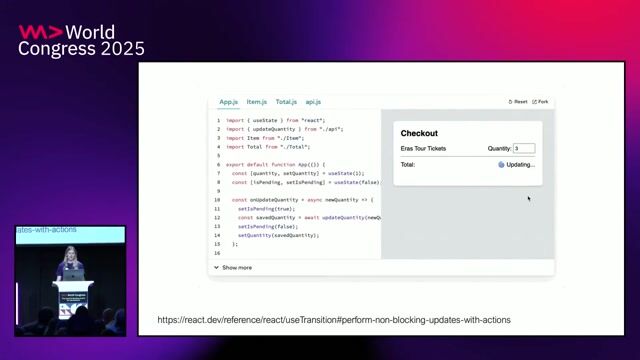
Solving UI challenges with a modern tech stack
Building Interactive Async UI with React 19 and Ariakit
03:28 MIN
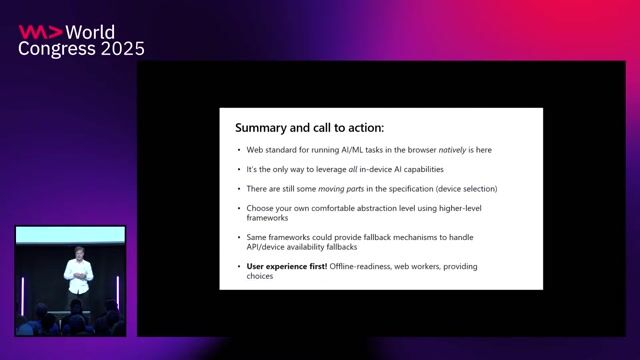
Best practices and the future of browser AI
Privacy-first in-browser Generative AI web apps: offline-ready, future-proof, standards-based

01:18 MIN
Why developers and businesses choose to use React
React and the power of visualisation
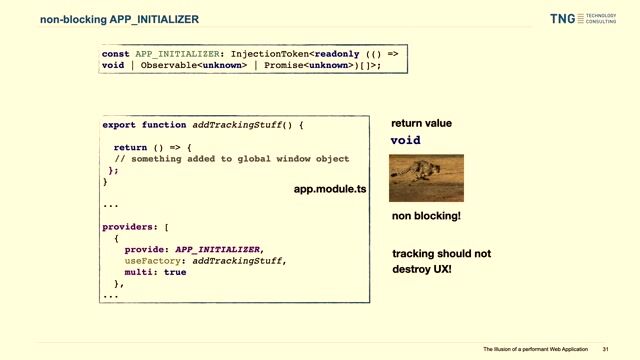
02:54 MIN
Enhancing runtime performance with CSS and UX
The Illusion of a Performant Web Application
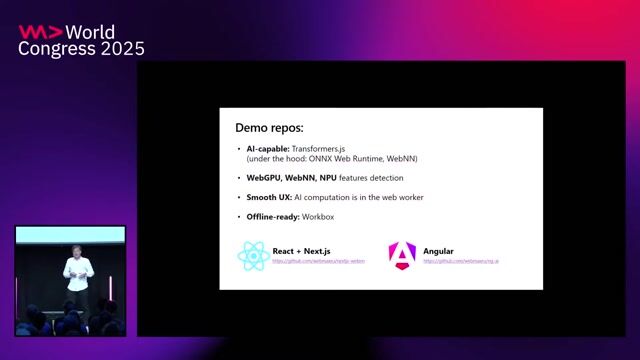
01:45 MIN
Demo code and using web workers for performance
Privacy-first in-browser Generative AI web apps: offline-ready, future-proof, standards-based
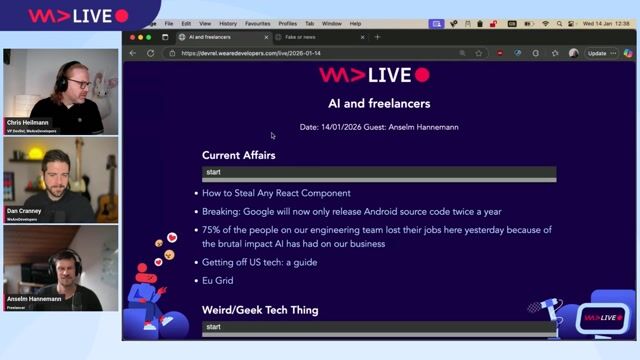
04:56 MIN
Recreating React components using AI and dev tools
WeAreDevelopers LIVE – AI, Freelancing, Keeping Up with Tech and More
01:58 MIN
Building with familiar React APIs and real CSS
Lynx: Native for More
Featured Partners
Related Videos
 40:24
40:24Snappy UI needs no Single-Page Application
Clemens Helm
 30:07
30:07Accessibility in React Application
Julia Undeutsch
 38:24
38:24Machine learning in the browser with TensorFlowjs
Håkan Silfvernagel
 43:08
43:08A journey of a long list in React
Adam Klein
 14:44
14:44Catching up on the basics you don't really need that much code
Chris Heilmann
 40:05
40:05Typescript, React and Atomic Design - a match made in heaven
Nathalia Rus
 27:23
27:23From ML to LLM: On-device AI in the Browser
Nico Martin
 25:22
25:22Building Interactive Async UI with React 19 and Ariakit
Aurora Scharff
Related Articles
View all articles



From learning to earning
Jobs that call for the skills explored in this talk.


&why GmbH
Berlin, Germany
€50-70K
Junior
Intermediate
Senior
React
Next.js
TypeScript


PiNCAMP GmbH
Berlin, Germany
Senior
React
GraphQL
Next.js