Daniel Roe
Building Better with Nuxt 3
#1about 2 minutes
Balancing creativity and constraint in developer tooling
Developer productivity is maximized when tooling removes constraints like configuration overhead, allowing for more creative problem-solving.
#2about 4 minutes
Learning from Nuxt 2 to define Nuxt 3 goals
Nuxt 2's success with conventions like file-based routing and a module ecosystem informed the four key goals for Nuxt 3's evolution.
#3about 3 minutes
Using a configuration schema for better documentation
Nuxt 3 uses a configuration schema with inline JSDoc to automatically generate type definitions, markdown docs, and rich editor autocompletion.
#4about 6 minutes
How automatic component imports speed up development
Components placed in the `components` directory are automatically available throughout the application, complete with type-safe prop checking in the editor.
#5about 6 minutes
Auto-registering plugins and composable functions
Nuxt 3 automatically registers plugins and imports exported functions from the `composables` directory, making them globally available without manual setup.
#6about 5 minutes
Introducing the high-performance Nitro server engine
Nitro is a minimal, fast server engine designed for low cold-start times, cross-platform deployment, and optimized bundle sizes using code-splitting.
#7about 4 minutes
Building type-safe APIs with Nitro and useFetch
Create server API routes that are automatically typed, allowing the `useFetch` composable to provide end-to-end type safety from the backend to the frontend.
#8about 4 minutes
Building and analyzing the optimized Nuxt 3 output
The build process creates a minimal, self-contained server output with code-splitting that dynamically loads only the necessary chunks for each request.
#9about 6 minutes
Q&A on bugs, testing, and production readiness
The team discusses handling bugs during the beta, ESM compatibility, the roadmap for component testing, and how to manage environment variables for deployment.
Related jobs
Jobs that call for the skills explored in this talk.

Hubert Burda Media
München, Germany
€80-95K
Intermediate
Senior
JavaScript
Node.js
+1


Matching moments

04:25 MIN
Rethinking frameworks with Nuxt, Nitro, and UnJS
Building for the Edge - Crafting a Next-Gen Framework

02:22 MIN
Understanding the core features of Nuxt 3
Nuxt.js - Just Vue 3 and a bit of magic?
03:37 MIN
The motivation behind Nuxt 3 and the UnJS ecosystem
Modern Web Development with Nuxt3
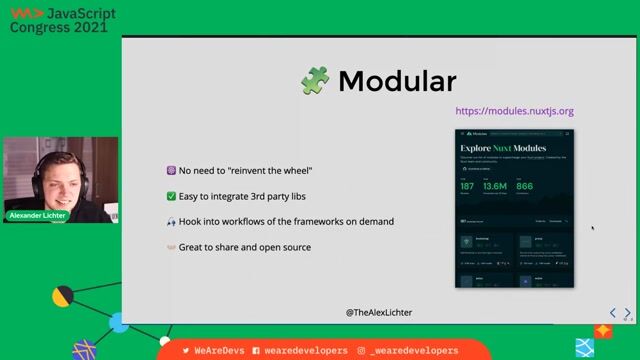
03:08 MIN
Enhancing the developer experience with modern tooling
Modern Web Development with Nuxt3
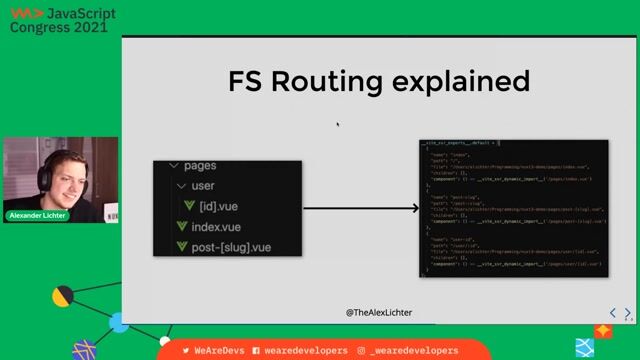
03:23 MIN
Built-in performance optimizations in Nuxt 3
Modern Web Development with Nuxt3
01:02 MIN
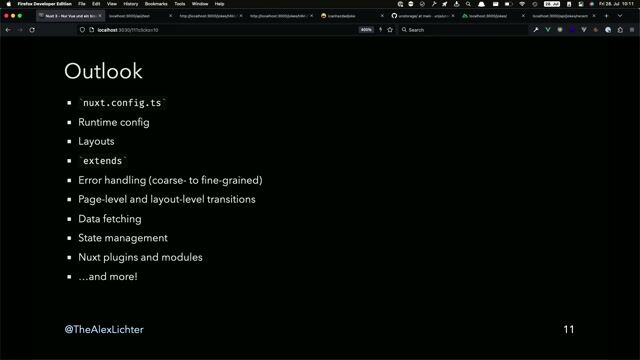
Summary of Nuxt's benefits and advanced features
Nuxt.js - Just Vue 3 and a bit of magic?

02:27 MIN
Understanding the Nuxt 2 foundation and its benefits
Modern Web Development with Nuxt3

05:42 MIN
Understanding Nuxt as a Vue-based meta-framework
WeAreDevelopers LIVE - Whats Nuxt and Next for app development, 20 years AJAX and more
Featured Partners
Related Videos
 26:32
26:32Nuxt.js - Just Vue 3 and a bit of magic?
Alexander Lichter
 41:43
41:43Modern Web Development with Nuxt3
Alexander Lichter
 42:21
42:21Fast & Furious - Going headless with Nuxt.js!
Samuel Snopko
 43:41
43:41Building for the Edge - Crafting a Next-Gen Framework
Daniel Roe
 44:31
44:31Vuejs and TypeScript- Working Together like Peanut Butter and Jelly
Rob Richardson
 59:15
59:15TresJS a new declarative ThreeJS as Vue components
Alvaro Saburido
 44:11
44:11Vue3 practical development
Mikhail Kuznetcov
 49:00
49:00Under The Hood of Vue 3 Reactivity
Marc Backes
Related Articles
View all articles



From learning to earning
Jobs that call for the skills explored in this talk.


Shortlister
York, United Kingdom
Remote
£60-80K
Senior
API
CSS
HTML
+8
AI FLOM
Rijswijk, Netherlands
Remote
Junior
PHP
GIT
JSON
MySQL
+12
SPM Sportplatz Media GmbH
Hamburg, Germany
PHP
API
Vue.js
Docker
Laravel
+1
ITproposal B.V.
Amsterdam, Netherlands
Senior
API
CSS
GIT
REST
Vue.js
+3