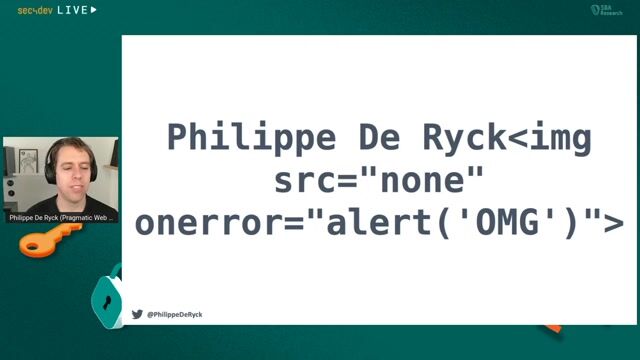
Philippe De Ryck
Securing Frontend Applications with Trusted Types
#1about 4 minutes
Understanding the real-world danger of cross-site scripting
Cross-site scripting (XSS) allows attackers to execute malicious code in a user's browser, with severe consequences like data theft.
#2about 4 minutes
How modern frameworks fail to prevent all XSS attacks
While frameworks like Angular and React encode data by default, properties like `dangerouslySetInnerHTML` create bypasses that reintroduce XSS risks.
#3about 6 minutes
Using sanitization to safely render dynamic HTML
Sanitizing user-provided HTML with libraries like DOMPurify is crucial for preventing XSS, especially when bypassing framework defaults.
#4about 7 minutes
How Trusted Types change browser behavior to block XSS
Enabling Trusted Types via a Content Security Policy header forces dangerous DOM sinks like `innerHTML` to reject strings and only accept safe, typed objects.
#5about 5 minutes
Using Trusted Types in development to secure all browsers
Even with limited browser support, using Trusted Types during development helps developers find and fix XSS vulnerabilities that benefit users on all platforms.
#6about 6 minutes
Securing third-party libraries with a default policy
A default Trusted Types policy can automatically sanitize insecure DOM assignments from third-party dependencies, securing your entire application.
#7about 13 minutes
Q&A on framework comparisons and advanced concepts
The speaker answers audience questions about Vue.js, server-side validation, policy injection risks, browser polyfills, and the future of native sanitization APIs.
Related jobs
Jobs that call for the skills explored in this talk.

Hubert Burda Media
München, Germany
€80-95K
Intermediate
Senior
JavaScript
Node.js
+1


Matching moments
02:15 MIN
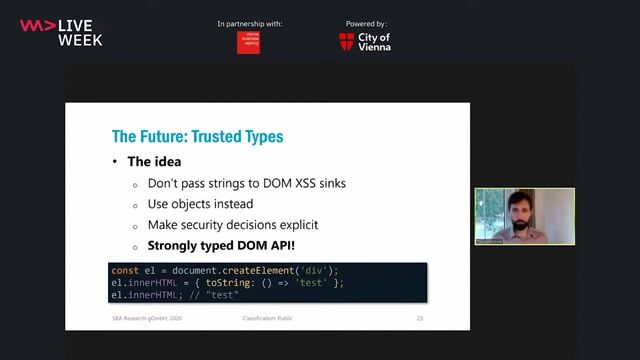
The future of XSS prevention with Trusted Types
A Primer in Single Page Application Security (Angular, React, Vue.js)
03:01 MIN
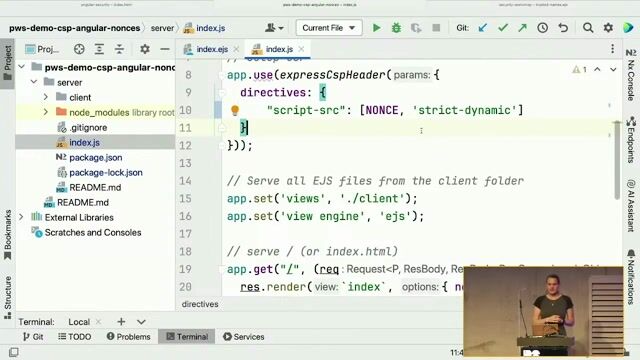
Introducing trusted types to secure dangerous dom sinks
Cross Site Scripting is yesterday's news, isn't it?
04:32 MIN
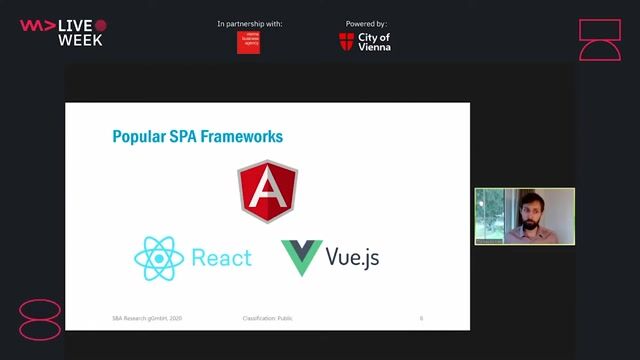
The primary security threat of cross-site scripting
A Primer in Single Page Application Security (Angular, React, Vue.js)
01:44 MIN
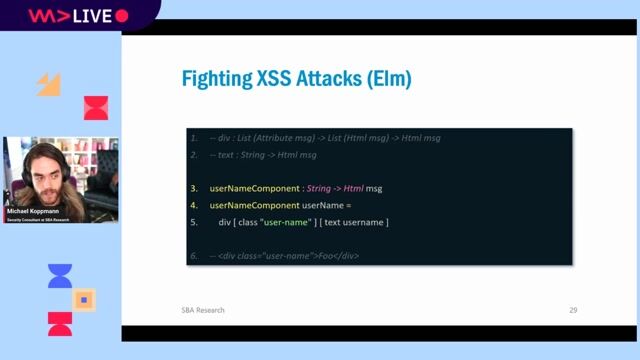
Eliminating XSS with a dedicated HTML type
Typed Security: Preventing Vulnerabilities By Design
03:21 MIN
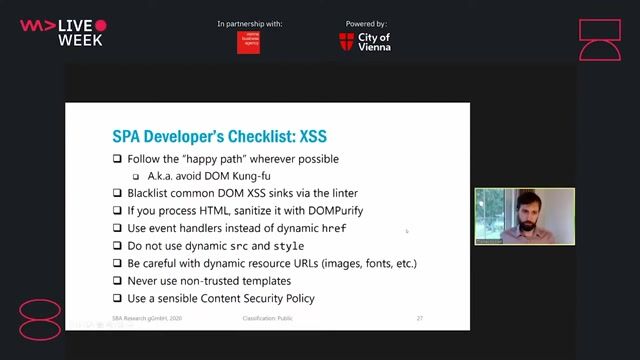
A practical checklist for preventing XSS in SPAs
A Primer in Single Page Application Security (Angular, React, Vue.js)
01:03 MIN
Q&A on common pitfalls and sanitization tools
101 Typical Security Pitfalls
03:26 MIN
Implementing trusted types with the dompurify library
Cross Site Scripting is yesterday's news, isn't it?
03:30 MIN
Essential web security best practices beyond SPAs
A Primer in Single Page Application Security (Angular, React, Vue.js)
Featured Partners
Related Videos
 36:39
36:39A Primer in Single Page Application Security (Angular, React, Vue.js)
Thomas Konrad
 30:54
30:54Cross Site Scripting is yesterday's news, isn't it?
Martina Kraus
 58:19
58:19Typed Security: Preventing Vulnerabilities By Design
Michael Koppmann
 29:34
29:34You can’t hack what you can’t see
Reto Kaeser
 29:47
29:47You click, you lose: a practical look at VSCode's security
Thomas Chauchefoin & Paul Gerste
 27:41
27:41Friend or Foe? TypeScript Security Fallacies
Liran Tal
 57:47
57:47Cracking the Code: Decoding Anti-Bot Systems!
Fabien Vauchelles
 26:59
26:59Security in modern Web Applications - OWASP to the rescue!
Jakub Andrzejewski
Related Articles
View all articles



From learning to earning
Jobs that call for the skills explored in this talk.


aXite Security Tools
Amsterdam, Netherlands
Node.js
Angular
JavaScript
Kryptos Technologies Ltd
Charing Cross, United Kingdom
API
DevOps
JavaScript
TypeScript
AWS Lambda
+3
Krell Consulting & Training
Senior
GIT
NestJS
Docker
Node.js
Angular
+6
Client Server
Charing Cross, United Kingdom
Remote
£100-120K
Senior
React
Python
Docker
+7
Stratech Logistic
Enschede, Netherlands
Remote
€5K
Senior
CSS
Scrum
Angular
+2