Thomas Konrad
A Primer in Single Page Application Security (Angular, React, Vue.js)
#1about 3 minutes
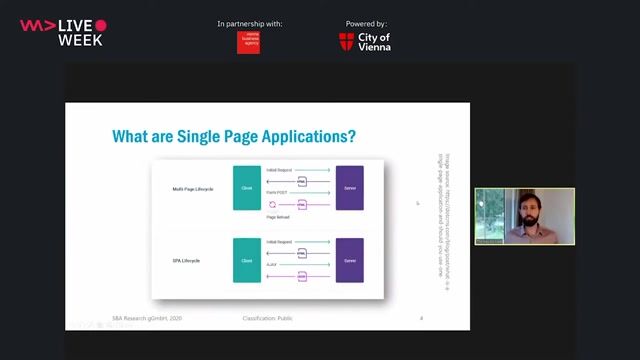
Understanding single page application architecture
Single page applications improve speed and separation of concerns by rendering HTML on the client-side and fetching data via APIs.
#2about 5 minutes
The primary security threat of cross-site scripting
Cross-site scripting (XSS) is the main vulnerability in SPAs, where untrusted data is mixed with markup, leading to malicious code execution in the user's browser.
#3about 3 minutes
How Angular, React, and Vue handle innerHTML security
Angular automatically sanitizes `innerHTML` to prevent XSS, while React's `dangerouslySetInnerHTML` and Vue's `v-html` require manual care.
#4about 4 minutes
Securing dynamic attributes like href and src
Dynamic `href` attributes can execute JavaScript via `javascript:` URLs, and dynamic `src` or `style` attributes also pose XSS risks.
#5about 3 minutes
Using DOMPurify for robust HTML sanitization
Use the DOMPurify library to safely render untrusted HTML in frameworks like React and Vue, or to customize Angular's strict default sanitizer.
#6about 3 minutes
Why you should avoid direct DOM manipulation
Bypassing framework template engines by using direct DOM functions like `document.write` or `eval` reintroduces significant XSS vulnerabilities.
#7about 3 minutes
Using Content Security Policy for defense in depth
Implement a Content Security Policy (CSP) via HTTP headers to restrict script sources and disable inline scripts, providing a strong second layer of defense against XSS.
#8about 2 minutes
The future of XSS prevention with Trusted Types
The upcoming Trusted Types CSP directive will prevent strings from being passed to dangerous DOM functions, effectively creating a strongly-typed and safer DOM API.
#9about 3 minutes
A practical checklist for preventing XSS in SPAs
Follow a security checklist that includes using framework templates, sanitizing HTML with DOMPurify, and implementing a Content Security Policy.
#10about 3 minutes
Managing security risks in third-party dependencies
Regularly scan your project's dependencies for known vulnerabilities using tools like `npm audit` and automate the update process to mitigate risks from external code.
#11about 4 minutes
Essential web security best practices beyond SPAs
Ensure overall application security by enforcing TLS, using SameSite cookies, correctly configuring CORS, and securing WebSocket connections.
Related jobs
Jobs that call for the skills explored in this talk.

Hubert Burda Media
München, Germany
€80-95K
Intermediate
Senior
JavaScript
Node.js
+1

Matching moments
04:02 MIN
How modern frameworks fail to prevent all XSS attacks
Securing Frontend Applications with Trusted Types
01:22 MIN
How SPAs came to dominate frontend development
Snappy UI needs no Single-Page Application

13:26 MIN
Q&A on framework comparisons and advanced concepts
Securing Frontend Applications with Trusted Types
02:37 MIN
Frontend developers now share responsibility for application security
Security in modern Web Applications - OWASP to the rescue!
04:25 MIN
The hidden complexities of single-page applications
Why HTMX is crushing React, Vue & Svelte.
01:03 MIN
Q&A on common pitfalls and sanitization tools
101 Typical Security Pitfalls

02:19 MIN
Questioning the default choice of SPAs for web development
Why HTMX is crushing React, Vue & Svelte.
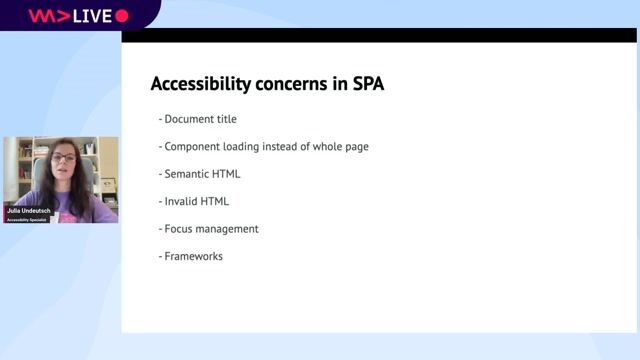
03:43 MIN
Common accessibility challenges in React SPAs
Accessibility in React Application
Featured Partners
Related Videos
 45:19
45:19Securing Frontend Applications with Trusted Types
Philippe De Ryck
 30:54
30:54Cross Site Scripting is yesterday's news, isn't it?
Martina Kraus
 40:24
40:24Snappy UI needs no Single-Page Application
Clemens Helm
 31:21
31:21Why I Recommend Svelte to Every New Web Developer
Markus Hatvan
 26:59
26:59Security in modern Web Applications - OWASP to the rescue!
Jakub Andrzejewski
 30:07
30:07Accessibility in React Application
Julia Undeutsch
 44:00
44:00SEO in Angular? No big deal with SSR and Angular Universal
Martina Kraus
 44:31
44:31Vuejs and TypeScript- Working Together like Peanut Butter and Jelly
Rob Richardson
Related Articles
View all articles



From learning to earning
Jobs that call for the skills explored in this talk.


aXite Security Tools
Amsterdam, Netherlands
Node.js
Angular
JavaScript
Accso - Accelerated Solutions GmbH
Köln, Germany
Remote
Senior
Java
Scrum
React
Python
+4
Translations.com
Barcelona, Spain
Senior
Scrum
React
Figma
Vue.js
Angular
+2