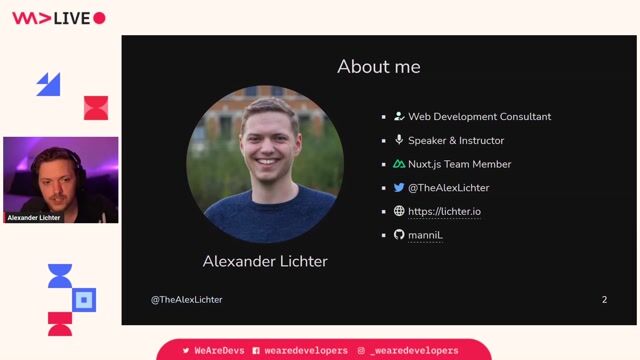
Alexander Lichter
petite-vue - Progressively enhancing every application?
#1about 4 minutes
The case for progressive enhancement in legacy applications
Many existing websites are not single-page applications, making progressive enhancement a necessary strategy to add modern interactivity without a full rewrite.
#2about 5 minutes
Evaluating different tools for adding interactivity
A comparison of using full Vue.js, vanilla JavaScript, and jQuery reveals the trade-offs in bundle size, complexity, and developer experience for enhancing existing sites.
#3about 3 minutes
Introducing petite-vue for lightweight reactivity
Petite-vue is a minimal 5.5KB subset of Vue.js that provides reactivity without a virtual DOM, making it ideal for progressive enhancement.
#4about 4 minutes
Initializing and scoping petite-vue applications
Learn how to automatically initialize petite-vue using the `init` attribute or manually mount it to specific DOM elements for targeted reactivity.
#5about 3 minutes
Managing global state and computed properties
Use the root scope in `createApp` to provide global data and methods, and implement computed properties with simple getter functions.
#6about 4 minutes
Handling lifecycle events and side effects
Petite-vue offers `@vue:mounted` and `@vue:unmounted` for lifecycle hooks and uses the `v-effect` directive to trigger side effects when reactive data changes.
#7about 3 minutes
Creating reusable components and templates
Abstract logic into reusable components by defining them as functions and deduplicate markup using the native `<template>` tag with the `$template` property.
#8about 1 minute
Understanding the limitations of petite-vue
Petite-vue intentionally omits advanced features from full Vue like render functions, Teleport, and Suspense to maintain its small size.
#9about 2 minutes
Comparing petite-vue with the Alpine.js framework
A look at how petite-vue was inspired by Alpine.js, which itself was inspired by Vue, highlighting their similarities and key differences in size and features.
#10about 1 minute
A decision tree for choosing the right tool
A simple guide helps you decide when to use Nuxt.js for greenfield projects, vanilla JS for tiny tasks, or petite-vue for enhancing existing applications.
#11about 6 minutes
Live coding a simple interactive component
A practical demonstration shows how to build an interactive element using `v-scope`, event handling, `v-if` for conditional rendering, and `v-cloak` to prevent flashes of unstyled content.
Related jobs
Jobs that call for the skills explored in this talk.

Hubert Burda Media
München, Germany
€80-95K
Intermediate
Senior
JavaScript
Node.js
+1

Matching moments
03:51 MIN
Accelerating development with a reusable Vue.js template
Navigating the Corporate Jungle: Life as a Developer in a large Company
02:35 MIN
Comparing Vue with other popular SPA frameworks
Vuejs and TypeScript- Working Together like Peanut Butter and Jelly
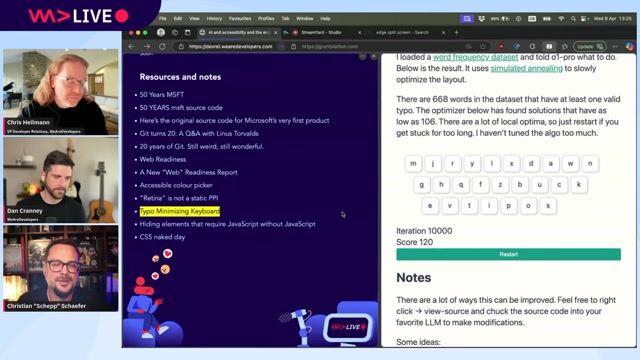
04:41 MIN
Progressive enhancement for JavaScript-dependent UI elements
WeAreDevelopers LIVE - 50 years Microsoft, Web Readiness Report, The German Web Community and more
05:49 MIN
The shift from jQuery to modern JavaScript frameworks
How Your Bundle Size Affects The Climate
03:54 MIN
Motivation for a modern Three.js library for Vue
TresJS a new declarative ThreeJS as Vue components

13:26 MIN
Q&A on framework comparisons and advanced concepts
Securing Frontend Applications with Trusted Types
01:13 MIN
Choosing micro-libraries over large frameworks
The Lean Web
06:10 MIN
The ongoing debate for JavaScript-free web solutions
WeAreDevelopers LIVE – Keeping Up with Styles, Data & More
Featured Partners
Related Videos
 54:44
54:44Under The Hood Of Vue 3 Reactivity
Marc Backes
 31:21
31:21Why I Recommend Svelte to Every New Web Developer
Markus Hatvan
 44:31
44:31Vuejs and TypeScript- Working Together like Peanut Butter and Jelly
Rob Richardson
 49:00
49:00Under The Hood of Vue 3 Reactivity
Marc Backes
 58:26
58:26TDD for Vue.js Developers
Markus Oberlehner
 50:10
50:10The Eternal Sunshine of the Zero Build Pipeline
M4dz
 40:24
40:24Snappy UI needs no Single-Page Application
Clemens Helm
 46:46
46:46The Lean Web
Chris Ferdinandi
Related Articles
View all articles



From learning to earning
Jobs that call for the skills explored in this talk.


Multiplied
Roosendaal, Netherlands
Remote
€5K
Intermediate
CSS
SASS
Scrum
+4