Ekaterina Sirazitdinova
Multimodal Generative AI Demystified
#1about 2 minutes
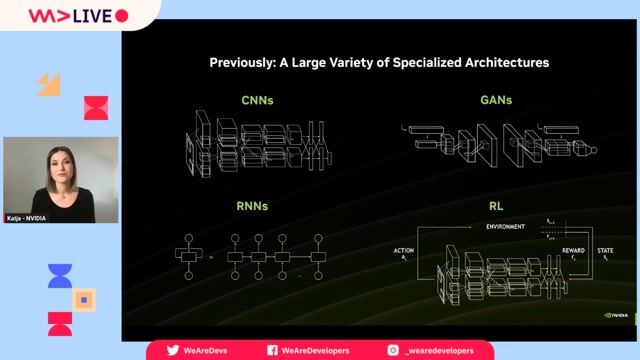
The shift from specialized AI to multimodal foundation models
Traditional specialized AI models like CNNs are not sustainable for general intelligence, leading to the rise of multimodal foundation models trained on internet-scale data.
#2about 3 minutes
Demonstrating the power of multimodal models like GPT-4
GPT-4 achieves high accuracy on zero-shot tasks and shows substantial performance gains by incorporating vision, even enabling it to reason about humor in images.
#3about 7 minutes
How multimodal generative AI is transforming industries
Generative AI offers practical applications across education, healthcare, engineering, and entertainment, from personalized learning to interactive virtual characters.
#4about 2 minutes
Understanding the core concepts of generative AI
Generative AI creates new content by learning patterns from existing data using a foundation model, which is a large transformer trained to predict the next element in a sequence.
#5about 7 minutes
A technical breakdown of the transformer architecture
The transformer architecture processes text by converting it into numerical embeddings and uses self-attention layers in its encoder-decoder structure to understand context.
#6about 3 minutes
An introduction to diffusion models for image generation
Modern image generation relies on diffusion models, which create high-quality images by learning to progressively remove noise from a random starting point.
#7about 3 minutes
Fine-tuning diffusion models for custom subjects and styles
Diffusion models can be fine-tuned on a small set of images to generate new content featuring a specific person, object, or artistic style.
#8about 5 minutes
The core components of text-to-image generation pipelines
Text-to-image models use a U-Net architecture to predict noise and a variational autoencoder to work efficiently in a compressed latent space.
#9about 3 minutes
Using CLIP to guide image generation with text prompts
Models like CLIP align text and image data into a shared embedding space, allowing text prompts to guide the diffusion process for controlled image generation.
#10about 3 minutes
Exploring advanced use cases and Nvidia's eDiff-I model
Image generation enables applications like synthetic asset creation and super-resolution, with models like Nvidia's eDiff-I focusing on high-quality, bias-free results.
Related jobs
Jobs that call for the skills explored in this talk.


Wilken GmbH
Ulm, Germany
Senior
Amazon Web Services (AWS)
Kubernetes
+1

Matching moments
05:32 MIN
GenAI applications and emerging professional roles
Enter the Brave New World of GenAI with Vector Search
04:05 MIN
Understanding the fundamental shift to generative AI
Your Next AI Needs 10,000 GPUs. Now What?
05:35 MIN
Understanding how generative AI models create content
The shadows that follow the AI generative models
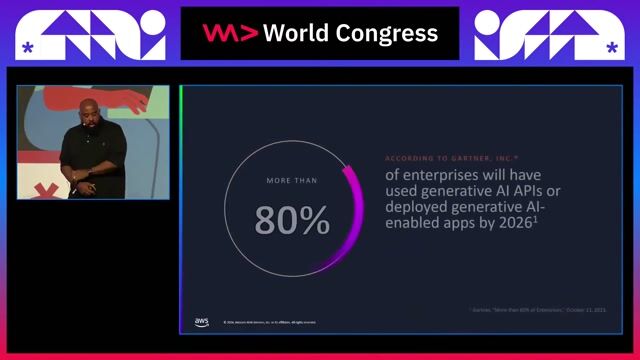
03:10 MIN
An overview of generative AI and its capabilities
Make it simple, using generative AI to accelerate learning
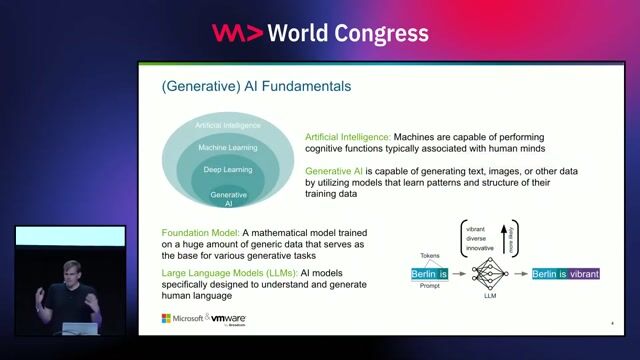
02:00 MIN
Understanding the fundamentals of generative AI for developers
Java Meets AI: Empowering Spring Developers to Build Intelligent Apps
07:44 MIN
Defining key GenAI concepts like GPT and LLMs
Enter the Brave New World of GenAI with Vector Search
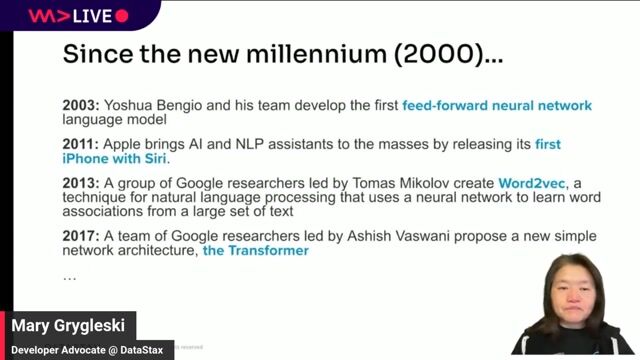
04:06 MIN
The recent evolution of generative AI models
Enter the Brave New World of GenAI with Vector Search
03:38 MIN
Tracing the evolution from LLMs to agentic AI
Exploring LLMs across clouds
Featured Partners
Related Videos
 59:39
59:39Building Products in the era of GenAI
Julian Joseph
 47:28
47:28What do language models really learn
Tanmay Bakshi
 35:16
35:16How AI Models Get Smarter
Ankit Patel
 30:38
30:38In the Dawn of the AI: Understanding and implementing AI-generated images
Timo Zander
 30:02
30:02The AI Elections: How Technology Could Shape Public Sentiment
Martin Förtsch & Thomas Endres
 30:24
30:24ChatGPT: Create a Presentation!
Markus Walker
 58:00
58:00Creating Industry ready solutions with LLM Models
Vijay Krishan Gupta & Gauravdeep Singh Lotey
 57:52
57:52Develop AI-powered Applications with OpenAI Embeddings and Azure Search
Rainer Stropek
Related Articles
View all articles

From learning to earning
Jobs that call for the skills explored in this talk.


Advanced Group
München, Germany
Remote
API
C++
Python
OpenGL
+6
Missionat Humanoid
Charing Cross, United Kingdom
Remote
£80-90K
Intermediate
Python
PyTorch
Machine Learning
WeCloudData
Remote
Python
Machine Learning
Continuous Integration
Ai Education
Remote
£70-75K
Python
Machine Learning
Natural Language Processing
LinkiT
Amsterdam, Netherlands
Azure
DevOps
Python
PySpark
Terraform
+2
Datashift
Mechelen, Belgium
Intermediate
Azure
Python
PyTorch
TensorFlow
Machine Learning
+1
The Rolewe
Charing Cross, United Kingdom
API
Python
Machine Learning