Tanmay Bakshi
What do language models really learn
#1about 7 minutes
The fundamental challenge of modeling natural language
Language models aim to create intuitive human-computer interfaces, but this is difficult because language syntax doesn't fully capture semantic meaning.
#2about 3 minutes
How deep learning models learn by transforming data
Deep learning works by performing a series of transformations on input data to warp its vector space until it becomes linearly separable.
#3about 3 minutes
Why the training objective is key to model behavior
The training objective, or incentive, dictates exactly what a model learns and can lead to unintended outcomes if not designed carefully.
#4about 8 minutes
From Word2Vec and LSTMs to modern transformers
The evolution from slow, non-contextual models like LSTMs to the parallel and deeply contextual transformer architecture solved major NLP challenges.
#5about 7 minutes
A practical demo of a character-level BERT model
A scaled-down, character-level transformer model demonstrates the 'fill in the blank' pre-training task by predicting masked characters in artist names.
#6about 2 minutes
What language models implicitly learn about language structure
By analyzing a model's internal weights, we can see it learns phonetic relationships and syntactic structures without ever being explicitly trained on them.
#7about 7 minutes
Why current generative models don't truly 'write'
Generative models like GPT are excellent at predicting the next word based on statistical patterns but lack the underlying thought process required for true, creative writing.
#8about 4 minutes
Exploring the future with Blank Language Models
Blank Language Models (BLM) offer a new training approach by filling in text in any order, forcing the model to consider both past and future context.
#9about 3 minutes
The need for better tooling to accelerate ML research
The complexity of implementing novel architectures like BLMs highlights the need for better infrastructure and compiled languages like Swift for TensorFlow to speed up innovation.
Related jobs
Jobs that call for the skills explored in this talk.


Wilken GmbH
Ulm, Germany
Senior
Amazon Web Services (AWS)
Kubernetes
+1
Matching moments
07:44 MIN
Defining key GenAI concepts like GPT and LLMs
Enter the Brave New World of GenAI with Vector Search
01:24 MIN
Understanding the fundamentals of large language models
Building Blocks of RAG: From Understanding to Implementation
02:26 MIN
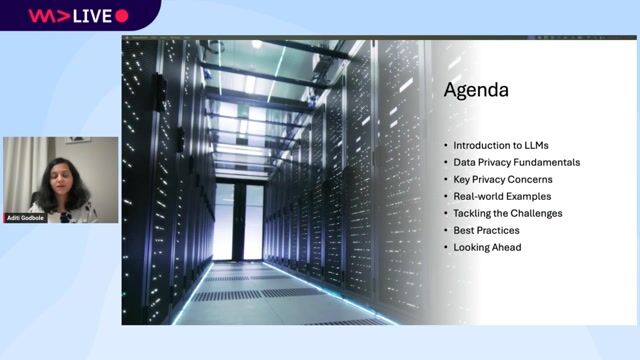
Understanding the core capabilities of large language models
Data Privacy in LLMs: Challenges and Best Practices

04:05 MIN
Understanding the basics of large language models
Bringing the power of AI to your application.
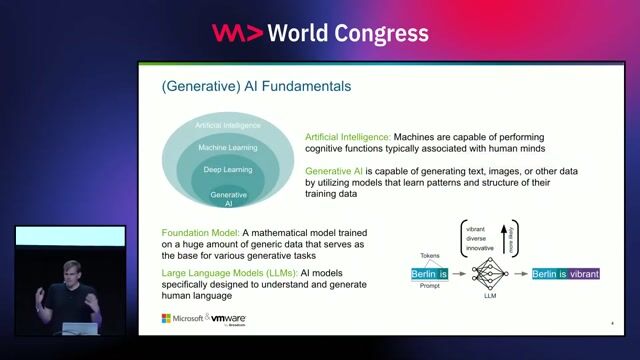
02:00 MIN
Understanding the fundamentals of generative AI for developers
Java Meets AI: Empowering Spring Developers to Build Intelligent Apps

03:01 MIN
The evolution of NLP from early models to modern LLMs
Harry Potter and the Elastic Semantic Search
03:30 MIN
Using large language models for voice-driven development
Speak, Code, Deploy: Transforming Developer Experience with Voice Commands
03:42 MIN
Using large language models as a learning tool
Google Gemini: Open Source and Deep Thinking Models - Sam Witteveen
Featured Partners
Related Videos
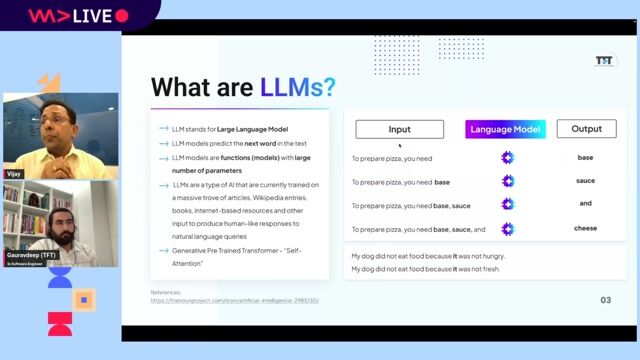 58:00
58:00Creating Industry ready solutions with LLM Models
Vijay Krishan Gupta & Gauravdeep Singh Lotey
 35:16
35:16How AI Models Get Smarter
Ankit Patel
 29:40
29:40Lies, Damned Lies and Large Language Models
Jodie Burchell
 23:50
23:50Data Privacy in LLMs: Challenges and Best Practices
Aditi Godbole
 56:55
56:55Multimodal Generative AI Demystified
Ekaterina Sirazitdinova
 25:17
25:17AI: Superhero or Supervillain? How and Why with Scott Hanselman
Scott Hanselman
 32:54
32:54The pitfalls of Deep Learning - When Neural Networks are not the solution
Adrian Spataru & Bohdan Andrusyak
 52:37
52:37Multilingual NLP pipeline up and running from scratch
Kateryna Hrytsaienko
Related Articles
View all articles.png?w=240&auto=compress,format)


.png?w=240&auto=compress,format)
From learning to earning
Jobs that call for the skills explored in this talk.


Fastino Labs
Guildford, United Kingdom
Remote
£65-100K
Senior
Docker
PyTorch
TensorFlow
+3
WeCloudData
Remote
Python
Machine Learning
Continuous Integration
PwC
Berlin, Germany
Remote
Senior
Python
FastAPI
Data analysis
Machine Learning
+1
Language Services Ltd
Glasgow, United Kingdom
Remote
£75-100K
Senior
Machine Learning
Microsoft Dynamics
Neural Concept
Großmehring, Germany
Fluid
Python
Machine Learning
Neural Concept
Lausanne, Switzerland
Fluid
Python
Machine Learning