Alex Waldherr
Quantum Computing - The tiny and the big challenges
#1about 2 minutes
The foundational physics behind quantum computing
The principles of atomic energy levels and specific light wavelengths form the basis for manipulating quantum systems.
#2about 2 minutes
An overview of qubits and quantum hardware architectures
Quantum computers operate by applying gates to qubits, which can be built using various hardware technologies like superconducting circuits.
#3about 3 minutes
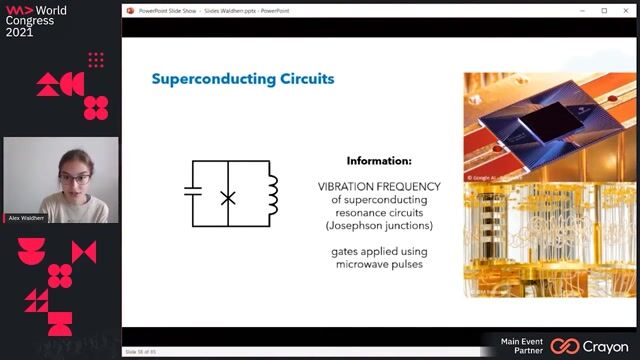
A deep dive into superconducting qubit design
Superconducting qubits use a capacitor-inductor circuit with a Josephson junction to create distinct, addressable energy levels for computation.
#4about 3 minutes
The major challenges in building quantum hardware
Building scalable quantum computers involves overcoming issues like qubit connectivity, stability (T1/T2 times), gate fidelity, and the lack of a single agreed-upon technology.
#5about 2 minutes
Exploring spin qubits and NMR technology
Alternative hardware approaches like spin qubits leverage transistor technology or Nuclear Magnetic Resonance (NMR), which was used to run the first Shor's algorithm.
#6about 4 minutes
Understanding the mathematics of quantum software
Quantum states are represented by wave functions or state vectors with complex coefficients, where each additional qubit exponentially increases the computational space.
#7about 2 minutes
Using quantum interference to build algorithms
Quantum algorithms use superposition and interference to constructively or destructively combine probabilities, amplifying the correct answers.
#8about 6 minutes
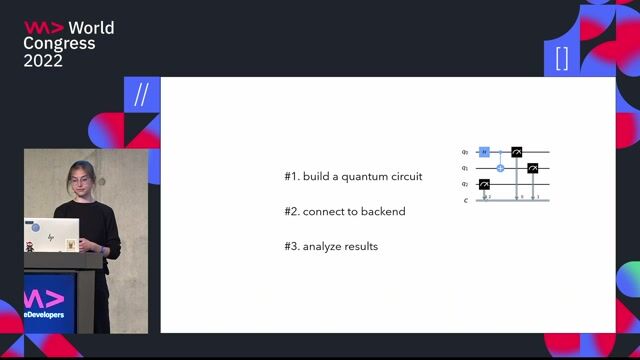
Live coding a simple quantum circuit with Qiskit
A step-by-step demonstration shows how to build and run a single-qubit interference circuit using Python and the Qiskit framework on a simulator.
#9about 2 minutes
Advanced software concepts and future challenges
Modern quantum programming involves concepts like observables and estimators, while facing challenges in error correction, data storage, and debugging.
#10about 2 minutes
A framework for responsible quantum technology development
Advancing the quantum field responsibly requires ensuring new ideas are technologically sound, unique, reproducible, and supported by educational materials.
Related jobs
Jobs that call for the skills explored in this talk.


Matching moments
02:22 MIN
Engineering challenges and building a quantum computer
What is quantum computing?
03:05 MIN
The future of quantum hardware and learning resources
Schroedinger's cat: Thinking in- and outside the box of quantum mechanics
05:18 MIN
A live demo building a basic quantum circuit
What is quantum computing?
04:15 MIN
A brief history of quantum hardware development
Quantum DevOps - Quantum Application Development

02:55 MIN
Exploring the IBM quantum computing platform
Schroedinger's cat: Thinking in- and outside the box of quantum mechanics
04:29 MIN
Q&A on the future and applications of quantum
What is quantum computing?
04:48 MIN
Understanding the fundamentals of quantum computing
Quantum computing for developers: Solving optimization problems with Qiskit
01:13 MIN
Key players and platforms in quantum computing
Schroedinger's cat: Thinking in- and outside the box of quantum mechanics
Featured Partners
Related Videos
 25:46
25:46What is quantum computing?
Alex Waldherr
 43:21
43:21Schroedinger's cat: Thinking in- and outside the box of quantum mechanics
Alexandra Waldherr
 28:04
28:04Going Quantum: The future of the internet ...
Alexander Pirker
 30:57
30:57The Quantum Computing Future
Tomislav Tipurić, Alexander Glätzle & Jan Goetz
 34:14
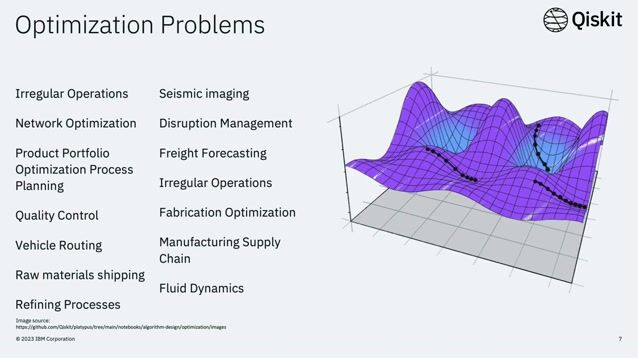
34:14Quantum computing for developers: Solving optimization problems with Qiskit
Isabell Heider & David Alber
 31:17
31:17Quantum Computing for Classical Developers
Julian Burr
 30:37
30:37The Quantum Leap: Redefining Computing and Its Applications
Tomislav Tipurić
 33:26
33:26Hands-on Journey to Quantum Computing with IBM
Jan-Rainer Lahmann
Related Articles
View all articles



From learning to earning
Jobs that call for the skills explored in this talk.


Quantinuum
Cambridge, United Kingdom
GIT
Rust
Python
eleQtron GmbH
Siegen, Germany
Intermediate
API
Python
Gitlab
Toshiba EMEA
Cambridge, United Kingdom
£31K
The Munich Quantum Valley (mqv) Ggmbh
Senior
EURECOM
Canton d'Antibes-3, France
Senior
PsiQuantum
Daresbury, United Kingdom
£140-160K
Senior
C++
REST
Python