
Tamas Piros
Jamstack and Web Performance, a match made in heaven
#1about 5 minutes
How the web has grown heavier over a decade
Statistics from the HTTP Archive show a dramatic increase in page weight and resource requests, especially for JavaScript and video.
#2about 6 minutes
Introducing the core concepts of Jamstack architecture
Jamstack decouples the frontend from the backend by serving pre-built markup from edge servers instead of traditional origin servers.
#3about 4 minutes
Using static site generators to pre-render markup
Static site generators (SSGs) render pages at build time, creating static HTML files that can be deployed directly to a CDN.
#4about 4 minutes
Adding dynamic functionality to sites with APIs
Third-party APIs for services like authentication, payments, and media management replace the need for custom server-side code execution.
#5about 3 minutes
Understanding the modern Git-based deployment workflow
A commit to a Git repository automatically triggers a build and atomic deployment of the site to a global CDN network.
#6about 5 minutes
How Jamstack provides performance benefits out of the box
The Jamstack architecture and its tooling ecosystem automatically handle many backend and frontend optimizations like caching, compression, and minification.
#7about 6 minutes
Using Lighthouse to audit your site's performance
A practical demonstration shows how to use the Lighthouse tool in Chrome DevTools to measure performance and Core Web Vitals.
#8about 4 minutes
Analyzing real user metrics with PageSpeed Insights
PageSpeed Insights provides crucial field data from real users, offering a more accurate performance picture than local lab tests alone.
#9about 4 minutes
Dramatically reducing image size with a CDN
Using an image CDN service like Cloudinary allows for automatic format and quality adjustments that significantly reduce file size.
Related jobs
Jobs that call for the skills explored in this talk.

Hubert Burda Media
München, Germany
€80-95K
Intermediate
Senior
JavaScript
Node.js
+1

Matching moments
04:11 MIN
How JAMstack improves the user experience through performance
Headless and JAMstack - The State of Commerce Today
04:33 MIN
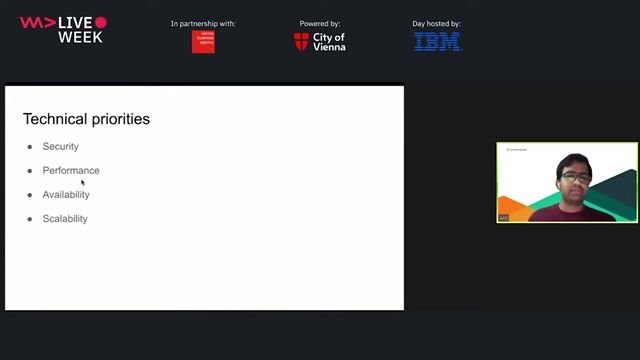
Addressing security, performance, and scalability in JAMstack
Headless and JAMstack - The State of Commerce Today

05:13 MIN
Using static site generators and Jamstack for efficiency
How Your Bundle Size Affects The Climate
03:20 MIN
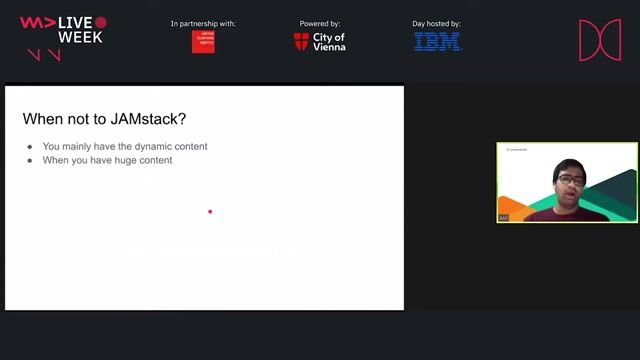
When not to use JAMstack and potential solutions
Headless and JAMstack - The State of Commerce Today
04:00 MIN
Understanding Jamstack architecture and incremental static generation
How Your Bundle Size Affects The Climate
03:24 MIN
Understanding JAMstack with a practical e-commerce example
Headless and JAMstack - The State of Commerce Today
02:29 MIN
The three core principles of a JAMstack mindset
Headless and JAMstack - The State of Commerce Today

03:01 MIN
An overview of the 2021 web developer survey
Web development best practices in 2021
Featured Partners
Related Videos
 32:56
32:56Web development: where are we, and where are we going?
Laurie Voss
 14:44
14:44Catching up on the basics you don't really need that much code
Chris Heilmann
 43:11
43:11The State Of The Web
Jeremy Keith
 39:24
39:24Headless and JAMstack - The State of Commerce Today
Anil Kumar Krishnashetty
 46:46
46:46The Lean Web
Chris Ferdinandi
 51:10
51:10Web development best practices in 2021
Laurie Voss
 27:27
27:27Things I learned while writing high-performance JavaScript applications
Michele Riva
 43:20
43:20Microfrontends at Scale
Josh Goldberg
Related Articles
View all articles


From learning to earning
Jobs that call for the skills explored in this talk.


PiNCAMP GmbH
Berlin, Germany
Senior
React
GraphQL
Next.js


Lightspeed
Ghent, Belgium
Remote
Senior
CSS
HTML
REST
React
+8
Client Server
Charing Cross, United Kingdom
Remote
£40-50K
React
Node.js
JavaScript
+1
The White Team
Tres Cantos, Spain
€28K
API
Node.js
Salesforce
Amazon Web Services (AWS)
Client Server
Cambridge, United Kingdom
Remote
£50-65K
FastAPI
Agile Methodologies
Client Server
St Albans, United Kingdom
Remote
£85-100K
Microservices
Amazon Web Services (AWS)
Client Server
St Albans, United Kingdom
Remote
£100K
Redis
Kafka
Angular
+6