Josh Goldberg
GraphQL + Apollo + Next.js: A Lovely Trio
#1about 5 minutes
Getting started with Next.js for React applications
Next.js provides file-system based routing and a Link component that enables fast, single-page application navigation with intelligent prefetching.
#2about 6 minutes
Exploring data fetching strategies in Next.js
Learn to pre-render pages with data using `getStaticProps` for build-time generation and `getServerSideProps` for fresh data on every request.
#3about 5 minutes
Implementing dynamic routes and using TypeScript
Create dynamic pages using bracket syntax in filenames and leverage Next.js's built-in support for TypeScript to add type safety to your components and props.
#4about 4 minutes
Understanding the core concepts of GraphQL APIs
GraphQL allows clients to request exactly the data they need by querying a well-defined schema, which enables powerful, auto-generated documentation and tooling.
#5about 3 minutes
How to build a GraphQL schema with resolvers
Define your API's capabilities by writing a GraphQL schema and implementing resolver functions that fetch the data for each field.
#6about 4 minutes
Using variables in queries and performing mutations
Pass dynamic values into your queries using variables and modify server-side data by defining and executing GraphQL mutations.
#7about 3 minutes
Auto-generating types with GraphQL Code Generator
Use GraphQL Code Generator to automatically create TypeScript types and even React hooks directly from your GraphQL schema and query files.
#8about 3 minutes
Connecting Next.js and GraphQL with Apollo Client
Integrate your GraphQL API into a Next.js application using Apollo Client to manage state, caching, and data fetching with generated React hooks.
#9about 4 minutes
The benefits of a composable JavaScript ecosystem
React's focused, single-purpose design fosters a rich ecosystem of specialized libraries, enabling developers to mix and match tools for rapid innovation.
#10about 2 minutes
Q&A on GraphQL federation and Next.js authentication
The speaker answers audience questions about using GraphQL to query multiple REST microservices and strategies for handling authentication.
Related jobs
Jobs that call for the skills explored in this talk.


Matching moments

03:55 MIN
An overview of Next.js and its optimization capabilities
Next.js Unleashed: Optimizing Web Vitals for superior User Experience
03:33 MIN
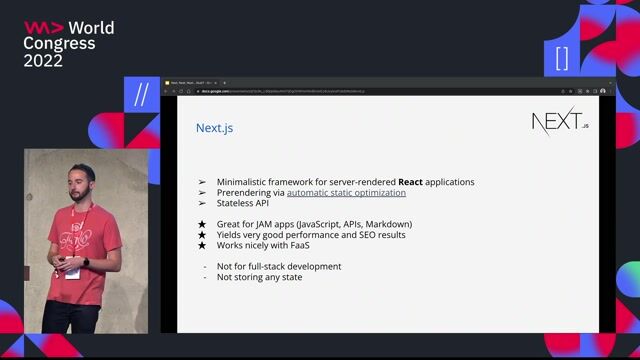
Creating hybrid React applications with Next.js
Next, Nest, Nuxt… Nust?
03:21 MIN
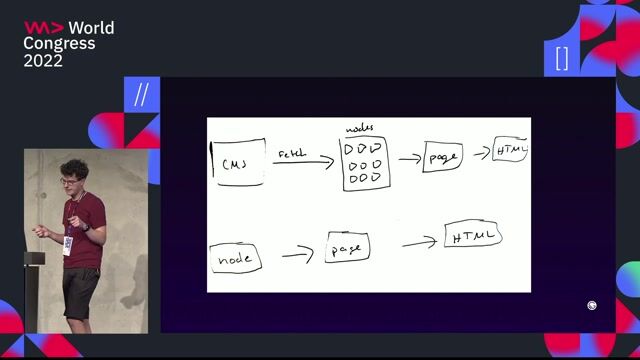
Exploring Gatsby's reactive, data-centric architecture
How Gatsby Cloud's real-time streaming architecture drives <5 second builds

06:37 MIN
Answering questions on headless architecture
Fast & Furious - Going headless with Nuxt.js!
04:04 MIN
Introducing GraphQL and its core concepts
GraphQL: Does it replace SQL, REST or Something Else?

05:40 MIN
A quick introduction to GraphQL fundamentals
GraphQL Mesh – Why GraphQL between services is the worst idea and the best idea at the same time!
05:42 MIN
A detailed breakdown of modern web frameworks
Web development best practices in 2021

11:34 MIN
Audience Q&A on tools, errors, and GraphQL
API Design - Getting Started
Featured Partners
Related Videos
 43:20
43:20Microfrontends at Scale
Josh Goldberg
 26:00
26:00To New Frontiers: The Future of Frontend Development
Rainer Hahnekamp
 28:12
28:12GraphQL: Does it replace SQL, REST or Something Else?
Gregor Bauer
 40:05
40:05Typescript, React and Atomic Design - a match made in heaven
Nathalia Rus
 47:48
47:48Putting the Graph In GraphQL With The Neo4j GraphQL Library
William Lyon
 26:30
26:30Next, Nest, Nuxt… Nust?
Marius Obert
 41:06
41:06Rethinking Reactive Architectures with GraphQL
David Leitner
 25:22
25:22Building Interactive Async UI with React 19 and Ariakit
Aurora Scharff
Related Articles
View all articles



From learning to earning
Jobs that call for the skills explored in this talk.


PiNCAMP GmbH
Berlin, Germany
Senior
React
GraphQL
Next.js


&why GmbH
Berlin, Germany
€50-70K
Junior
Intermediate
Senior
React
Next.js
TypeScript


Staffworx Ltd
Nottingham, United Kingdom
Remote
£80K
Senior
API
GIT
REST
+9
ITproposal B.V.
Amsterdam, Netherlands
Remote
Senior
CSS
SASS
REST
Scrum
+5
GULP Information Services GmbH
Augsburg, Germany
Intermediate
.NET
Azure
React
Next.js
JavaScript
+2
Brantner Digital Solutions
Charing Cross, United Kingdom
Remote
£45-65K
Senior
CSS
GIT
AJAX
+14
Provectus
Remote
API
GIT
JSON
REST
+11
SkyBound
Southampton, United Kingdom
Remote
£45-75K
Senior
GIT
REST
Azure
+10