Marius Obert
Next, Nest, Nuxt… Nust?
#1about 5 minutes
Choosing a framework using the State of JS survey
The State of JS survey reveals that while Express.js is widely used, frameworks like Next.js, Gatsby, and Nuxt.js are rapidly gaining popularity.
#2about 5 minutes
Comparing web rendering strategies for modern applications
Understand the differences and trade-offs between client-side rendering, server-side rendering, static site generation, and pre-rendering for performance and SEO.
#3about 2 minutes
Building static sites with Gatsby and React
Gatsby is a React-based static site generator ideal for Jamstack applications with its rich plugin ecosystem and focus on performance.
#4about 4 minutes
Creating hybrid React applications with Next.js
Next.js extends React with pre-rendering, automatic static optimization, and serverless functions, making it a versatile choice for hybrid applications.
#5about 2 minutes
Using Nuxt.js for server-rendered Vue.js applications
Nuxt.js provides a powerful framework for building server-rendered applications with Vue.js, offering similar capabilities to Next.js.
#6about 3 minutes
Building a full-stack backend with NestJS
NestJS is a progressive Node.js framework for building efficient and scalable server-side applications with features like TypeORM and a modular architecture.
#7about 2 minutes
Comparing framework popularity and community support
A data-driven comparison of Next.js, Gatsby, Nuxt.js, and NestJS based on npm downloads, GitHub activity, and community size helps in choosing a well-supported tool.
#8about 2 minutes
How to choose the right JavaScript framework
Use a decision tree based on your application's architecture, such as full-stack needs or specific rendering strategies, to select the most suitable framework.
#9about 1 minute
Q&A on Deno's maturity and framework preference
The speaker discusses why Deno was not considered mature enough in 2020 and reaffirms a personal preference for using NestJS for backend development.
Related jobs
Jobs that call for the skills explored in this talk.

Hubert Burda Media
München, Germany
€80-95K
Intermediate
Senior
JavaScript
Node.js
+1


tree-IT GmbH
Bad Neustadt an der Saale, Germany
€54-80K
Intermediate
Senior
Java
TypeScript
+1
Matching moments
05:42 MIN
A detailed breakdown of modern web frameworks
Web development best practices in 2021

02:51 MIN
An introduction to the Nest.js framework
Nest.js - TypeScript in the backend can also be clean

04:25 MIN
Rethinking frameworks with Nuxt, Nitro, and UnJS
Building for the Edge - Crafting a Next-Gen Framework

03:55 MIN
An overview of Next.js and its optimization capabilities
Next.js Unleashed: Optimizing Web Vitals for superior User Experience

02:49 MIN
Comparing frameworks for building multi-page applications
Marko.js: Unsung Hero of Scalable Web Frameworks
04:07 MIN
Contrasting developer interest with actual framework usage statistics
To New Frontiers: The Future of Frontend Development

06:38 MIN
Comparing Fastify with NestJS and Express
1, 2, 3... Fastify!
05:49 MIN
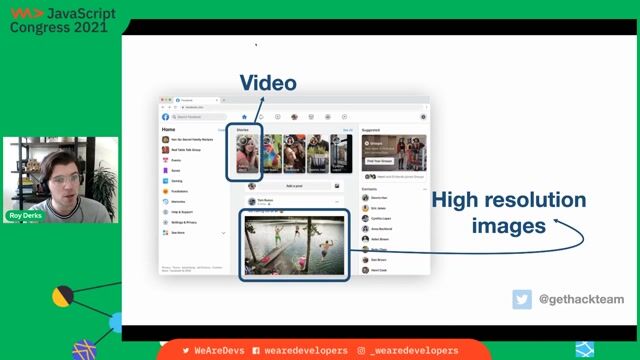
The shift from jQuery to modern JavaScript frameworks
How Your Bundle Size Affects The Climate
Featured Partners
Related Videos
 51:10
51:10Web development best practices in 2021
Laurie Voss
 30:40
30:40What the heck do "declarative" and "reactive" actually mean?
André Kovac
 43:20
43:20Microfrontends at Scale
Josh Goldberg
 32:56
32:56Web development: where are we, and where are we going?
Laurie Voss
 26:00
26:00To New Frontiers: The Future of Frontend Development
Rainer Hahnekamp
 43:57
43:57How to Stop Choosing JavaScript Frameworks and Start Living
Sasha Shynkevich
 30:42
30:42One Framework To Rule Them All: Faster Websites With Astro
Eddy Vinck
 40:45
40:45GraphQL + Apollo + Next.js: A Lovely Trio
Josh Goldberg
Related Articles
View all articles



From learning to earning
Jobs that call for the skills explored in this talk.


&why GmbH
Berlin, Germany
€50-70K
Junior
Intermediate
Senior
React
Next.js
TypeScript


PiNCAMP GmbH
Berlin, Germany
Senior
React
GraphQL
Next.js


Vesterling Consulting GmbH
Paderborn, Germany
Remote
NoSQL
Scrum
NestJS
Node.js
+6
Brantner Digital Solutions
Charing Cross, United Kingdom
Remote
£45-65K
Senior
CSS
GIT
AJAX
+14
GULP Information Services GmbH
Augsburg, Germany
Intermediate
.NET
Azure
React
Next.js
JavaScript
+2
Randstad
Barcelona, Spain
Remote
€40-57K
Senior
Azure
React
DevOps
+5
Provectus
Remote
API
GIT
JSON
REST
+11