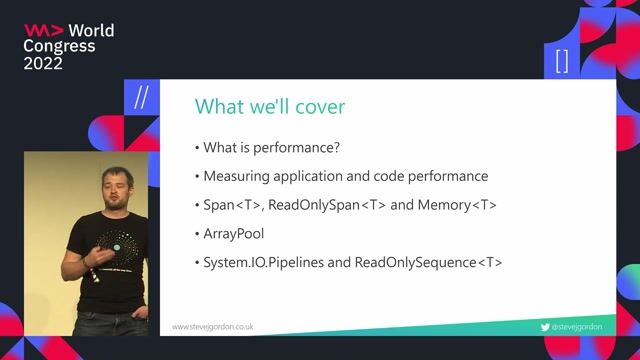
Steve Gordon
Turbocharged: Writing High-Performance C# and .NET Code
#1about 2 minutes
Defining performance metrics for .NET applications
Performance is defined by three key metrics: execution time, throughput, and memory allocations, which influence garbage collection frequency.
#2about 1 minute
Adopting a scientific approach to code optimization
Follow a simple, iterative cycle of measuring with data, optimizing a small part of the code, and then measuring again to validate improvements.
#3about 2 minutes
Choosing the right tools for performance measurement
Use tools like Visual Studio diagnostic tools for profiling and Benchmark.NET for precise micro-benchmarking of specific code paths.
#4about 2 minutes
Getting started with Benchmark.NET for micro-benchmarking
Benchmark.NET is an open-source library that provides high-precision measurements for small units of code by handling warm-up and statistical analysis.
#5about 3 minutes
Understanding Span<T> for efficient memory operations
Span<T> provides a type-safe, read/write view over a contiguous region of memory, such as arrays or stack-allocated memory, without new allocations.
#6about 4 minutes
Using Span<T> slicing to optimize array operations
Slicing a span creates a new view over a portion of the original data in constant time, avoiding the overhead of creating new arrays and copying data.
#7about 2 minutes
Parsing strings without allocations using ReadOnlySpan<char>
Create a `ReadOnlySpan<char>` from a string to parse it by slicing, which avoids creating new substring allocations and reduces memory pressure.
#8about 3 minutes
Navigating Span<T> limitations with Memory<T>
Since `Span<T>` is a stack-only `ref struct`, use the `Memory<T>` type in heap-based scenarios like async methods, then get a span from it when needed.
#9about 4 minutes
Case study: Optimizing S3 object key generation
A practical example shows how replacing string arrays and regex with `Span<T>` and stack allocation dramatically reduced memory allocations from 1KB to 192 bytes per operation.
#10about 2 minutes
Reusing temporary buffers with ArrayPool
Use `ArrayPool<T>` to rent and return temporary arrays, which reduces garbage collection pressure by reusing buffers instead of allocating new ones repeatedly.
#11about 2 minutes
Implementing high-performance I/O with System.IO.Pipelines
System.IO.Pipelines simplifies efficient stream processing by managing buffers from an `ArrayPool`, allowing you to work with data as it becomes available.
#12about 4 minutes
Case study: Parsing large files with pipelines
By replacing a library that loaded an entire file into memory with a pipeline-based parser, allocations were reduced from over 7.2 GB to 242 MB.
#13about 2 minutes
Making the business case for performance optimization
Translate performance gains like reduced allocations and increased throughput into monetary value, such as lower infrastructure costs, to get buy-in from stakeholders.
#14about 3 minutes
Summary of key principles for high-performance code
Always measure your code, focus on hot paths, avoid memory copies by using `Span<T>`, and consider `ArrayPool` and `Pipelines` for I/O-heavy scenarios.
#15about 4 minutes
Q&A: Span to array costs and using ValueTasks
The Q&A covers the cost of converting a span back to an array and discusses when to use `ValueTask` over `Task` to avoid allocations in synchronous completion paths.
Related jobs
Jobs that call for the skills explored in this talk.


Wilken GmbH
Ulm, Germany
Senior
Amazon Web Services (AWS)
Kubernetes
+1
Matching moments
01:00 MIN
Using micro-benchmarking for performance hotspots
What you can learn from an open-source project with 500 million downloads
04:40 MIN
Core strategies for achieving high performance
The Design and Evolution of C++
05:18 MIN
Advanced performance tuning with AOT and dependencies
In-depth .NET Azure Functions: Flex plan, Isolated mode and performance

07:45 MIN
Q&A on production code analysis and performance bottlenecks
Data Science on Software Data

02:35 MIN
The critical need for performance in modern applications
In-Memory Computing - The Big Picture

02:04 MIN
Balancing performance metrics beyond raw speed
Things I learned while writing high-performance JavaScript applications

07:15 MIN
Advanced WebAssembly memory optimization techniques
Uncharted Territories of Web Performance - Andrew Burnett-Thompson and David Burleigh

06:05 MIN
Optimizing code by understanding the V8 runtime
Things I learned while writing high-performance JavaScript applications
Featured Partners
Related Videos
 12:52
12:525 features that help you get the most out of C# 10
Louëlla Creemers
 31:13
31:13Tips, tricks and quirks in .NET
Paweł Łukaszuk
 41:54
41:54Hacking C# from the inside - how to do anything in NET
Adam Furmanek
 38:45
38:45C# 13 Unleashed: Live Demos of my Top 10 Cutting-Edge Features!
Ambesh Singh & Sachin Kumar
 26:34
26:34Asynchronicity and multithreading in C#
Grzegorz Lang
 57:23
57:23Exploring the Latest Features of .NET and C# by Building a Game
Rainer Stropek
 24:36
24:36C# Lowering - What is it and why should I care?
Steven Giesel
 27:27
27:27Things I learned while writing high-performance JavaScript applications
Michele Riva
Related Articles
View all articles



From learning to earning
Jobs that call for the skills explored in this talk.


Lorenz Life Science Group
Frankfurt am Main, Germany
Senior
C#
.NET


Client Server
St Albans, United Kingdom
Remote
£100K
Redis
Kafka
Angular
+6
Client Server
St Albans, United Kingdom
Remote
£85-100K
JavaScript
Microservices
Amazon Web Services (AWS)
Advanced Micro Devices
Cambridge, United Kingdom
C++
Scripting (Bash/Python/Go/Ruby)
Client Server
Newcastle upon Tyne, United Kingdom
£150K
Senior
API
C++
Java
Python
+2
Client Server
St Albans, United Kingdom
Remote
£85-100K
Microservices
Amazon Web Services (AWS)
Understanding Recruitment
Charing Cross, United Kingdom
Java
Docker
Kubernetes
Agile Methodologies
Google Cloud Platform
+3
Eu Recruit
Cambridge, United Kingdom