Ekaterina Sirazitdinova
Graph Neural Networks: What’s behind the Hype?
#1about 2 minutes
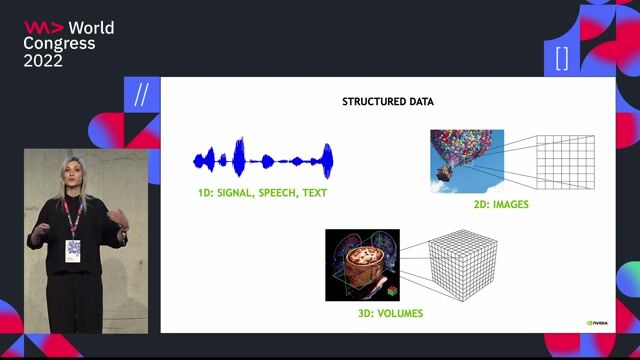
Why graph neural networks excel with unstructured data
Graph neural networks are uniquely suited for unstructured data like 3D meshes and social networks where traditional CNNs struggle.
#2about 3 minutes
Reviewing core concepts from graph theory
Key graph theory concepts are explained, including nodes, edges, directed vs undirected graphs, and homogeneous vs heterogeneous graphs.
#3about 2 minutes
Choosing the right data structure for graphs
An adjacency matrix is suitable for small graphs, while an adjacency list is more spatially efficient for large, sparse graphs.
#4about 3 minutes
A brief refresher on deep learning fundamentals
The core deep learning process of training and inference is reviewed, along with the distinction between supervised and unsupervised learning.
#5about 6 minutes
Exploring graph, node, and edge level prediction tasks
GNNs can perform predictions at the graph level (molecule properties), node level (community detection), and edge level (recommendation systems).
#6about 4 minutes
Understanding the GNN training and data splitting process
GNNs are trained using the message passing algorithm to create node embeddings, followed by a transductive split for training and validation sets.
#7about 2 minutes
Frameworks and resources for building GNNs
Popular frameworks like DGL, PyTorch Geometric, and TensorFlow GNN simplify the implementation of graph neural networks.
#8about 1 minute
Summary of key concepts in graph neural networks
The talk concludes with a recap of key takeaways, including graph modeling, data representation, prediction tasks, and the message passing algorithm.
#9about 3 minutes
Q&A on data leakage, knowledge graphs, and embeddings
The Q&A session addresses audience questions about data leakage in transductive splits, applying GNNs to semantic knowledge graphs, and comparing graph embeddings to word embeddings.
Related jobs
Jobs that call for the skills explored in this talk.


Picnic Technologies B.V.
Amsterdam, Netherlands
Intermediate
Senior
Python
Structured Query Language (SQL)
+1

Matching moments

14:06 MIN
Exploring the role and ethics of AI in gaming
Devs vs. Marketers, COBOL and Copilot, Make Live Coding Easy and more - The Best of LIVE 2025 - Part 3

05:17 MIN
Shifting from traditional CVs to skill-based talent management
From Data Keeper to Culture Shaper: The Evolution of HR Across Growth Stages

04:28 MIN
Building an open source community around AI models
AI in the Open and in Browsers - Tarek Ziadé

02:20 MIN
The evolving role of the machine learning engineer
AI in the Open and in Browsers - Tarek Ziadé

04:17 MIN
Playing a game of real or fake tech headlines
WeAreDevelopers LIVE – You Don’t Need JavaScript, Modern CSS and More

05:09 MIN
Why specialized models outperform generalist LLMs
AI in the Open and in Browsers - Tarek Ziadé

03:55 MIN
The hardware requirements for running LLMs locally
AI in the Open and in Browsers - Tarek Ziadé

04:09 MIN
How Python became the dominant language for AI
AI in the Open and in Browsers - Tarek Ziadé
Featured Partners
Related Videos
 46:51
46:51Graphs and RAGs Everywhere... But What Are They? - Andreas Kollegger - Neo4j
 24:44
24:44Knowledge graph based chatbot
Tomaz Bratanic
 29:11
29:11Large Language Models ❤️ Knowledge Graphs
Michael Hunger
 24:42
24:42Martin O'Hanlon - Make LLMs make sense with GraphRAG
Martin O'Hanlon
 29:50
29:50Trends, Challenges and Best Practices for AI at the Edge
Ekaterina Sirazitdinova
 56:55
56:55Multimodal Generative AI Demystified
Ekaterina Sirazitdinova
 42:56
42:56Geometric deep learning for drug discovery
Noah Weber
 22:07
22:07WWC24 - Ankit Patel - Unlocking the Future Breakthrough Application Performance and Capabilities with NVIDIA
Ankit Patel
Related Articles
View all articles



From learning to earning
Jobs that call for the skills explored in this talk.


Graphcore
Bristol, United Kingdom
£51K
Junior
C++
PyTorch
Machine Learning
Association Bernard Gregory
Adobe Analytics
Machine Learning
The University Of Göttingen
€208K
Python
Machine Learning
Cypress Semiconductor Corporation
Garching b. München, Germany
Senior
Python
Nvidia
Remote
Intermediate
C++
Python
Machine Learning
Software Architecture
Nvidia
Bramley, United Kingdom
C++
PyTorch
TensorFlow
Cypress Semiconductor Corporation
Garching b. München, Germany
Senior
Neo4j
Python
PyTorch
TensorFlow
Data analysis