Sayed Bouzouraa
Automated Driving - Why is it so hard to introduce
#1about 3 minutes
Defining the core challenge of automated driving
The fundamental question of why fully automated cars are not yet available is explored, setting the stage for a discussion on technical and organizational challenges.
#2about 2 minutes
Audi's history of automated driving concepts and studies
Audi's journey with automated driving includes early concepts like the A8, which introduced laser scanners but revealed perception system limitations for true Level 3 responsibility.
#3about 2 minutes
The crucial difference between assisted and automated driving
Assisted driving (Level 2) is a mature technology where the driver is responsible, while automated driving (Level 3+) is a disruptive shift that transfers responsibility to the car.
#4about 2 minutes
Understanding the automation dilemma in vehicle control
As automation capability increases, the driver's ability to manage system errors decreases, making the leap from Level 2 to Level 3 a fundamental challenge rather than an incremental improvement.
#5about 2 minutes
Why evolving assisted driving systems fails for automation
The automotive industry's attempt to incrementally improve assisted driving (Level 2) into automated driving (Level 3) is flawed because they are fundamentally different problems requiring separate development approaches.
#6about 2 minutes
The challenge of proving a positive risk balance
To release an automated system, carmakers must prove it's safer than a human driver by satisfying numerous criteria including safety KPIs, functional safety, and regional traffic laws.
#7about 3 minutes
Managing the endless complexity of real-world corner cases
Automated systems must handle a long tail of rare and complex scenarios, suggesting a need for shared, multi-layered knowledge bases and marketplaces for scenario data.
#8about 1 minute
Using prediction models to measure system performance
Prediction models help track the 'corner case rate' over time, showing that finding the most difficult and rare system errors becomes exponentially harder as development progresses.
#9about 3 minutes
Why environment perception is the weakest link
Environment perception is a major challenge because sensors react to the entire complex world, making it difficult to create an analytical model of their behavior and reliably detect anomalies.
#10about 3 minutes
Real-world examples of sensor interpretation failures
Practical examples, such as misinterpreting the moon as a traffic light or camera blindness from sudden light changes, highlight the profound difficulty of reliable sensor data interpretation.
#11about 2 minutes
The challenge of closed-loop system behavior and feedback
A system's reaction to sensor data can create complex feedback loops, where the car's movement alters sensor input and confirms false positives, a problem only discoverable in closed-loop testing.
#12about 2 minutes
Adopting agile systems engineering for complex development
The complexity of automated driving requires a shift to agile systems engineering and product-oriented organizational structures, such as cross-functional 'event chain teams' with end-to-end responsibility.
#13about 2 minutes
The multidisciplinary future of automated driving development
The future of automated driving lies in the successful combination of diverse fields like systems engineering, safety, software development, and data science to solve these complex challenges.
Related jobs
Jobs that call for the skills explored in this talk.


envelio
Köln, Germany
Remote
Senior
Python
Software Architecture

Wilken GmbH
Ulm, Germany
Senior
Amazon Web Services (AWS)
Kubernetes
+1
Matching moments
11:29 MIN
Identifying risks and challenges in autonomous driving systems
On developing smartphones on wheels

06:13 MIN
Skills and challenges of working with automotive AI
Developing an AI.SDK
02:44 MIN
The complexity of AI in safety-critical automotive software
Developing an AI.SDK
04:36 MIN
Introducing the CARIAD and Bosch automated driving alliance
Code to Road in < 12 hours
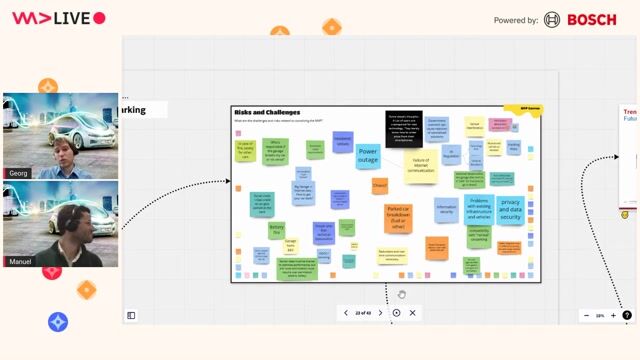
07:29 MIN
Q&A on automotive technologies and legal liability
The future of automotive mobility: Upcoming E/E architectures, V2X and its challenges
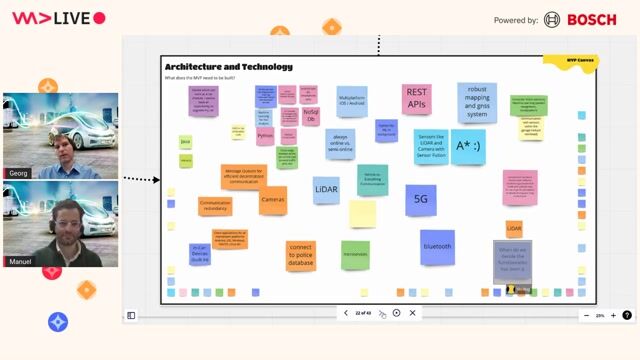
10:21 MIN
Identifying risks and challenges for autonomous systems
The future of automotive mobility: Upcoming E/E architectures, V2X and its challenges
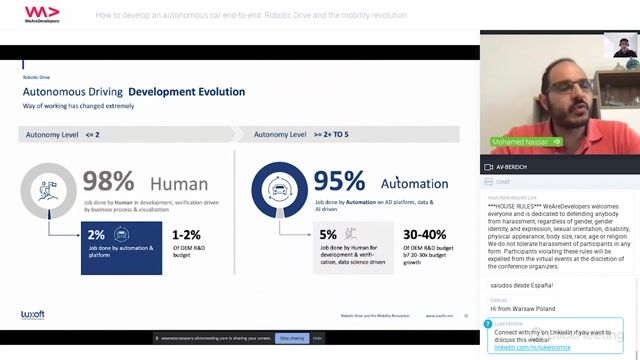
02:39 MIN
Understanding the disruptive shift to high-level vehicle autonomy
How to develop an autonomous car end-to-end: Robotic Drive and the mobility revolution
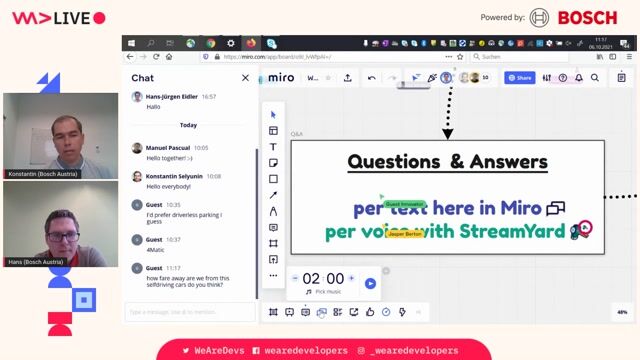
19:26 MIN
Q&A on the timeline and challenges for self-driving cars
On developing smartphones on wheels
Featured Partners
Related Videos
 38:12
38:12Developing an AI.SDK
Daniel Graff & Andreas Wittmann
 1:18:27
How to develop an autonomous car end-to-end: Robotic Drive and the mobility revolution
Ulrich Wurstbauer & Mohamed Nassar
 48:01
48:01What non-automotive Machine Learning projects can learn from automotive Machine Learning projects
Jan Zawadzki
 26:55
26:55How Machine Learning is turning the Automotive Industry upside down
Jan Zawadzki
 1:51:43
On developing smartphones on wheels
Hans-Jürgen Eidler
 19:24
19:24Finding the unknown unknowns: intelligent data collection for autonomous driving development
Liang Yu
 1:47:33
The future of automotive mobility: Upcoming E/E architectures, V2X and its challenges
Georg Kühberger & Manuel Pascual
 58:48
58:48Software stack under and over the hood of the fastest accelerating car in the world
Denis Grahovac
Related Articles
View all articles



From learning to earning
Jobs that call for the skills explored in this talk.


CARIAD
Berlin, Germany
Junior
Intermediate
C++
Python
Machine Learning


RIB Deutschland GmbH
Stuttgart, Germany
Python
Machine Learning
BMW AG
München, Germany
Senior
DevOps
Python
Grafana
Terraform
Prometheus
+4
Mobileye
Senior
C++
Python
Software Architecture
Scripting (Bash/Python/Go/Ruby)
Porsche Lizenz- und Handelsgesellschaft mbH & Co. KG
Senior
C++
Python
Matlab
Scripting (Bash/Python/Go/Ruby)
dspace digital signal processing and control engineering GmbH
Paderborn, Germany
VHDL
Elevate AI
Wolfsburg, Germany
€36-48K
Senior
GIT
Bash
Azure
Python
+5