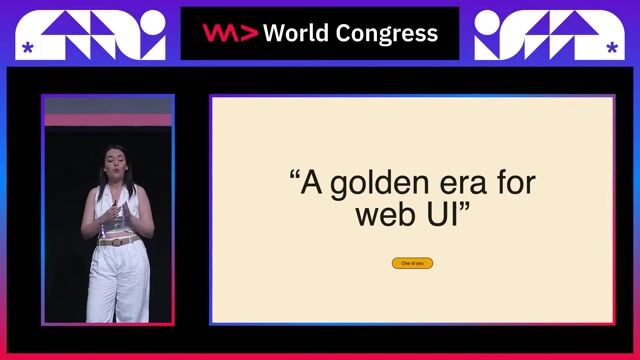
Cleyra Uzcategui
What’s New and What’s Next in Web UI
#1about 2 minutes
Understanding Baseline for cross-browser feature compatibility
The Baseline initiative helps developers identify which new web features are safely supported across all major browsers.
#2about 4 minutes
Building component-driven layouts with container queries
Container queries allow styling child elements based on a parent container's size and style properties, enabling more modular responsive components.
#3about 3 minutes
Using the CSS :has() selector for parent and sibling styling
The `:has()` pseudo-class acts as a parent selector, allowing you to style an element based on its children or subsequent siblings.
#4about 4 minutes
Improving typography and layout with modern CSS properties
New CSS properties like `text-wrap: balance`, `initial-letter`, dynamic viewport units, and wide-gamut colors offer more refined control over visual presentation.
#5about 3 minutes
Organizing stylesheets with CSS nesting and cascade layers
Native CSS nesting and cascade layers provide powerful tools to manage style specificity and organize code without pre-processors.
#6about 1 minute
Avoiding style collisions with native scoped CSS
The upcoming `@scope` rule will allow developers to natively scope styles to specific elements, preventing style leaks and naming collisions.
#7about 2 minutes
Building accessible UIs with the native Popover API
The `popover` attribute provides built-in functionality for top-layer promotion, light-dismiss behavior, and accessibility, reducing the need for JavaScript.
#8about 2 minutes
Creating scroll-driven and discrete property animations
Animate previously non-animatable properties with discrete animations and create dynamic effects tied to scroll position using scroll-driven animations.
#9about 1 minute
The future of web UI is declarative and customizable
The latest web platform features focus on providing more declarative APIs, reducing the need for scripting and enabling greater customization.
Related jobs
Jobs that call for the skills explored in this talk.


Hubert Burda Media
München, Germany
€80-95K
Intermediate
Senior
JavaScript
Node.js
+1
Matching moments

04:56 MIN
Current challenges and the future direction of CSS
WeAreDevelopers LIVE - Yes, CSS Can Do That!

17:51 MIN
Discussion on the evolution and future of CSS
What's new in CSS for Designers?

10:04 MIN
Analyzing the new Web Readiness Report and modern CSS
WeAreDevelopers LIVE - 50 years Microsoft, Web Readiness Report, The German Web Community and more

18:32 MIN
The rise of natively stylable HTML components in CSS
WeAreDevelopers LIVE - Yes, CSS Can Do That!
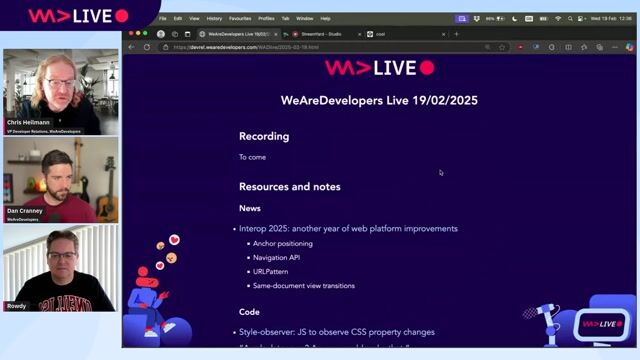
06:46 MIN
Exploring new browser APIs in Interop 2025
New Browser APIs, End of React Create App, Smuggling Data in Emoji and more with Rowdy Rabouw
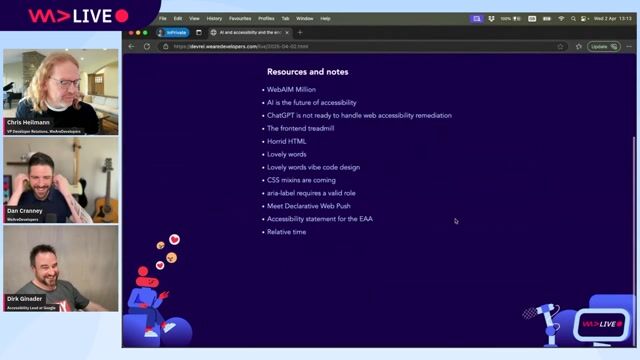
09:58 MIN
Rediscovering HTML elements and upcoming CSS features
WeAreDevelopers LIVE - Can AI save Accessibility?; Horrid HTML; The Frontend Treadmill and more

01:35 MIN
The future of the web is collapsing complexity
Fireside Chat with David Heinemeier Hansson
03:18 MIN
Relying on native browser features and the platform
The Lean Web
Featured Partners
Related Videos
 44:43
44:43Explore new web features before everyone else
Nikita Dubko
 59:20
59:20What's new in CSS for Designers?
Onur Gumus
 1:06:44
WeAreDevelopers LIVE – You Don’t Need JavaScript, Modern CSS and More
Chris Heilmann, Daniel Cranney & Theodore Lefevre
 37:55
37:55Future-Proof CSS
Ire Aderinokun
 14:44
14:44Catching up on the basics you don't really need that much code
Chris Heilmann
 24:17
24:17View-Transition-API: Gamechanger for hybrid app-development
Sascha Lehmann
 41:54
41:54Extending HTML with Web Components
Rowdy Rabouw
 43:11
43:11The State Of The Web
Jeremy Keith
Related Articles
View all articles



From learning to earning
Jobs that call for the skills explored in this talk.


&why GmbH
Berlin, Germany
€50-70K
Junior
Intermediate
Senior
React
Next.js
TypeScript


Wavestone
Canton of Courbevoie-2, France
Wavestone
Canton of Courbevoie-2, France