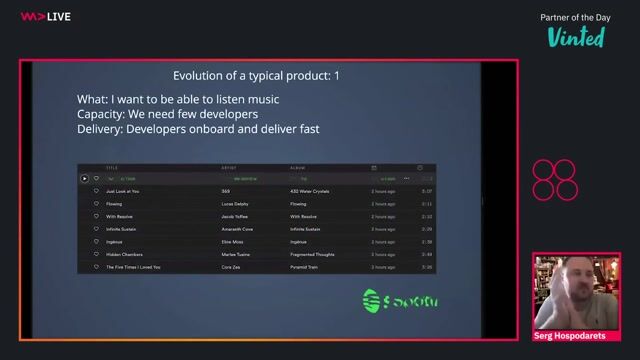
Serg Hospodarets
Front-End Micro Apps
#1about 4 minutes
Understanding the scaling challenges of monolithic applications
A product's growth from a simple feature to a complex system demonstrates how monolithic codebases slow down development and onboarding.
#2about 2 minutes
The architectural evolution from monoliths to micro-frontends
Software architecture has evolved from monoliths to frontend/backend splits and microservices, with micro-frontends being the next logical step for UI complexity.
#3about 5 minutes
Using Webpack 5 Module Federation for micro-frontends
Webpack 5's native Module Federation provides a standardized and widely adopted tool for building micro-frontends, avoiding the niche nature of other frameworks.
#4about 3 minutes
Live demo of a shell app consuming a micro-app
A practical demonstration shows how a shell application dynamically imports and renders a separate micro-app, both locally and from a deployed URL.
#5about 2 minutes
Differentiating micro-frontends from micro-apps
A micro-app combines the frontend focus of a micro-frontend with the backend concerns of a microservice to perform a single, well-defined task.
#6about 5 minutes
Exploring practical use cases for micro-apps
Micro-apps can be used for design system components, team autonomy, gradual migrations, and building a portfolio of applications from shared parts.
#7about 2 minutes
Coordinating shared dependencies and versions
A central platform team or guild should define and enforce exact versions for core shared dependencies like React to ensure consistency across all micro-apps.
#8about 5 minutes
Avoiding common pitfalls with micro-frontends
Key challenges include managing version deployments, handling CORS, ensuring security by avoiding third-party scripts, and implementing proper error boundaries.
#9about 2 minutes
Managing global UI state and communication patterns
Use singleton providers from the shell application for global UI elements like modals and notifications to prevent duplication and maintain control.
#10about 1 minute
Knowing when not to use a micro-frontend architecture
Micro-frontends should only be considered for transactional features or when organizational needs require separate deployment cadences; otherwise, a simple component is better.
#11about 2 minutes
Key takeaways for adopting micro-frontends
Successful adoption relies on using modern tools like Webpack 5, ensuring the architecture fits the organizational structure, and maintaining strong coordination.
Related jobs
Jobs that call for the skills explored in this talk.

Hubert Burda Media
München, Germany
€80-95K
Intermediate
Senior
JavaScript
Node.js
+1

Matching moments
05:24 MIN
The role of micro-frontends in scaling development teams
Micro-Frontends with Module Federation: Beyond the Basics
13:10 MIN
Audience Q&A on practical micro-frontend challenges
Micro-frontends anti-patterns
04:06 MIN
The historical challenge of building micro frontends
The Microfrontend Revolution- Using Webpack 5 Module Federation with Angular

06:11 MIN
Tracing the architectural evolution to microfrontends
Microfrontends with Blazor: Welcome to the Party!
03:01 MIN
Integrating applications using a micro-frontend architecture
Building the Right Product and Building It Right: A Glimpse into Extreme Programming, Atomic Design

01:25 MIN
Understanding the micro frontend architectural style
Micro Frontends with Module Federation: Why and How?
04:34 MIN
Conclusion and key takeaways on micro frontends
Micro Frontends with Module Federation: Why and How?

01:49 MIN
Understanding micro frontends and team autonomy
Advanced Micro Frontends: Multi-Version and Multi-Framework Scenarios
Featured Partners
Related Videos
 33:18
33:18The Microfrontend Revolution- Using Webpack 5 Module Federation with Angular
Manfred Steyer
 45:40
45:40Micro Frontends with Module Federation: Why and How?
Manfred Steyer
 43:20
43:20Microfrontends at Scale
Josh Goldberg
 41:49
41:49Destructuring Frontend monoliths with MicroFrontends
Trishul Goel
 40:24
40:24Snappy UI needs no Single-Page Application
Clemens Helm
 44:35
44:35Micro-Frontends with Module Federation: Beyond the Basics
Manfred Steyer
 43:08
43:08On tour with heroes == Moving from Angular to WebComponents
Benjamin Glusa
 28:05
28:05Independently together: how micro-applications improve developer experience + app performance
Bilal Cinarli
Related Articles
View all articles



From learning to earning
Jobs that call for the skills explored in this talk.


&why GmbH
Berlin, Germany
€50-70K
Junior
Intermediate
Senior
React
Next.js
TypeScript


Frontier Resourcing
Cardiff, United Kingdom
£50-80K
GIT
React
Vue.js
Node.js
+4