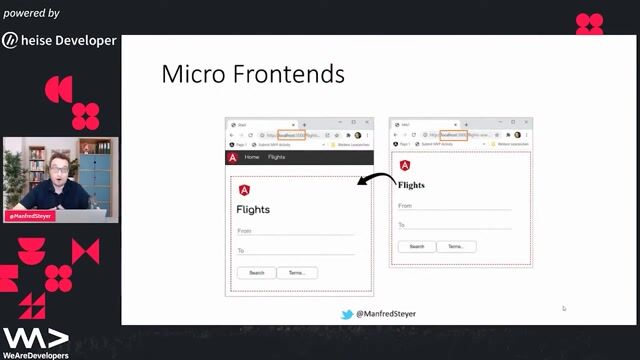
Manfred Steyer
Micro Frontends with Module Federation: Why and How?
#1about 3 minutes
Software architecture is about evaluating consequences
Software architecture is not about finding the single best solution, but about evaluating the consequences of different approaches for your specific situation.
#2about 1 minute
Understanding the micro frontend architectural style
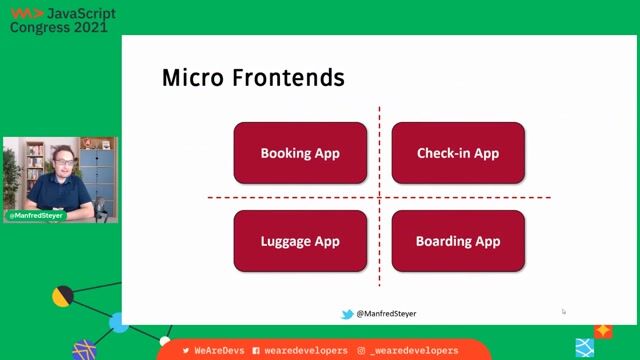
Micro frontends break down a large application into smaller, independently developed and deployed parts that are integrated into a common shell at runtime.
#3about 5 minutes
Exploring real-world use cases for micro frontends
Case studies from healthcare, payroll, and banking illustrate how large organizations use micro frontends to manage complexity across different business domains.
#4about 3 minutes
The primary reasons for adopting micro frontends
The main drivers for adopting micro frontends are scaling development across multiple teams, enabling long-term technology evolution, and quickly adapting to changing requirements.
#5about 3 minutes
Common challenges and implementation drawbacks
Implementing micro frontends introduces challenges such as the effort to build an orchestration layer, difficulties in sharing code at runtime, and maintaining a consistent user experience.
#6about 5 minutes
How Module Federation enables runtime integration
Module Federation, a Webpack 5 feature, allows a host application to dynamically load code from a separately compiled remote application, solving a key challenge for micro frontends.
#7about 2 minutes
Sharing libraries and handling version conflicts
Module Federation simplifies sharing common libraries like Angular or React to reduce bundle sizes and includes built-in strategies to manage potential version mismatches between micro frontends.
#8about 5 minutes
Live demo: Initial setup with an Angular plugin
A live demonstration shows how to use an Angular CLI plugin to quickly add the necessary builders and initial Webpack configuration for Module Federation to a project.
#9about 6 minutes
Live demo: Configuring the host and remote
The Webpack configuration is adjusted to expose a module from the remote micro frontend and define the remote's URL in the host shell application for lazy loading.
#10about 4 minutes
Implementing dynamic federation at runtime
The implementation is refactored from static federation to dynamic federation, allowing the application to determine which micro frontends to load at runtime from a backend configuration.
#11about 4 minutes
Combining Module Federation with Web Components
Using Web Components with Module Federation allows for mixing different frameworks and versions in one application, but requires careful handling to avoid conflicts.
#12about 5 minutes
Conclusion and key takeaways on micro frontends
Micro frontends are primarily a solution for scaling teams and domains, and while they introduce runtime dependencies, Module Federation provides a straightforward implementation path.
Related jobs
Jobs that call for the skills explored in this talk.

Hubert Burda Media
München, Germany
€80-95K
Intermediate
Senior
JavaScript
Node.js
+1

Matching moments
05:24 MIN
The role of micro-frontends in scaling development teams
Micro-Frontends with Module Federation: Beyond the Basics
04:47 MIN
Using Webpack 5 Module Federation for micro-frontends
Front-End Micro Apps
13:10 MIN
Audience Q&A on practical micro-frontend challenges
Micro-frontends anti-patterns
02:57 MIN
Integrating micro frontends with module federation
Advanced Micro Frontends: Multi-Version and Multi-Framework Scenarios
01:31 MIN
Key takeaways and resources for further learning
The Microfrontend Revolution- Using Webpack 5 Module Federation with Angular
04:06 MIN
The historical challenge of building micro frontends
The Microfrontend Revolution- Using Webpack 5 Module Federation with Angular
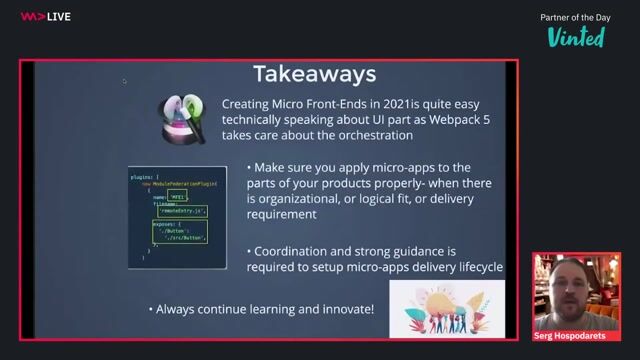
02:17 MIN
Key takeaways for adopting micro-frontends
Front-End Micro Apps
01:34 MIN
Key takeaways for building multi-version frontends
Advanced Micro Frontends: Multi-Version and Multi-Framework Scenarios
Featured Partners
Related Videos
 44:35
44:35Micro-Frontends with Module Federation: Beyond the Basics
Manfred Steyer
 33:18
33:18The Microfrontend Revolution- Using Webpack 5 Module Federation with Angular
Manfred Steyer
 24:47
24:47Advanced Micro Frontends: Multi-Version and Multi-Framework Scenarios
Manfred Steyer
 29:36
29:36Native Federation: The Future of Micro Frontends and Plugin-Systems in Angular
Manfred Steyer
 35:17
35:17Front-End Micro Apps
Serg Hospodarets
 43:20
43:20Microfrontends at Scale
Josh Goldberg
 40:05
40:05Stairway to Heaven - Scaling Frontends the Right Way
Florian Rappl
 40:17
40:17Micro-frontends anti-patterns
Luca Mezzalira
Related Articles
View all articles

.gif?w=240&auto=compress,format)

From learning to earning
Jobs that call for the skills explored in this talk.


&why GmbH
Berlin, Germany
€50-70K
Junior
Intermediate
Senior
React
Next.js
TypeScript


PiNCAMP GmbH
Berlin, Germany
Senior
React
GraphQL
Next.js


BPCS Consulting Services GmbH
München, Germany
€70-85K
Intermediate
React
Vue.js
TypeScript


byte5 digital media GmbH
Frankfurt am Main, Germany
Remote
Junior
CSS
HTML
React
Figma
+5
ACONEXT Stuttgart GmbH
Frankfurt am Main, Germany
Remote
Senior
CSS
GIT
HTML
JSON
+13
Multiplied
The Hague, Netherlands
Remote
Intermediate
API
CSS
HTML
React
+5
Smart Working Solutions
Nesseaue, Germany
Remote
Senior
CSS
HTML
REST
Vue.js
+6