Manfred Steyer
Micro-Frontends with Module Federation: Beyond the Basics
#1about 5 minutes
The role of micro-frontends in scaling development teams
Micro-frontends enable scaling by splitting large applications into smaller parts managed by autonomous teams, with module federation providing the necessary runtime integration.
#2about 8 minutes
The basics of configuring module federation
Module federation uses a host and remote model, where the host application uses dynamic imports to load exposed files from separately deployed remote applications.
#3about 7 minutes
Strategies for managing library version mismatches
Module federation handles version mismatches by default by selecting the highest compatible version, but can be configured with singletons or strict version checks for more control.
#4about 8 minutes
Loading micro-frontends with dynamic federation
Dynamic federation allows loading micro-frontends without upfront configuration by using a helper function and the Webpack runtime API to dynamically construct routes.
#5about 6 minutes
Comparing mono-repos and multiple repos for micro-frontends
Choosing between multiple repositories for strict decoupling or a mono-repository for easier code sharing involves trade-offs in dependency management and version control.
#6about 7 minutes
Building a multi-framework Frankenstein architecture
It is possible to integrate applications built with different frameworks like React or Vue by using a wrapper component to bootstrap them inside a host application.
#7about 2 minutes
Key takeaways for advanced module federation usage
A summary of advanced module federation techniques including version mismatch strategies, dynamic loading, repository structures, and multi-framework integration.
Related jobs
Jobs that call for the skills explored in this talk.

Hubert Burda Media
München, Germany
€80-95K
Intermediate
Senior
JavaScript
Node.js
+1

Matching moments
02:57 MIN
Integrating micro frontends with module federation
Advanced Micro Frontends: Multi-Version and Multi-Framework Scenarios
04:47 MIN
Using Webpack 5 Module Federation for micro-frontends
Front-End Micro Apps
05:28 MIN
How Module Federation enables runtime integration
Micro Frontends with Module Federation: Why and How?
04:34 MIN
Conclusion and key takeaways on micro frontends
Micro Frontends with Module Federation: Why and How?
13:10 MIN
Audience Q&A on practical micro-frontend challenges
Micro-frontends anti-patterns

05:18 MIN
Understanding Webpack 5 Module Federation concepts
The Microfrontend Revolution- Using Webpack 5 Module Federation with Angular
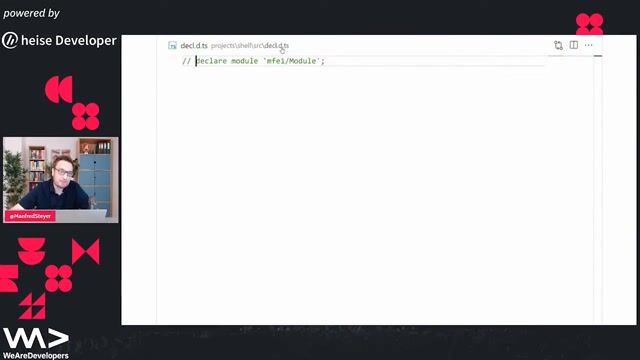
04:08 MIN
Implementing dynamic federation at runtime
Micro Frontends with Module Federation: Why and How?
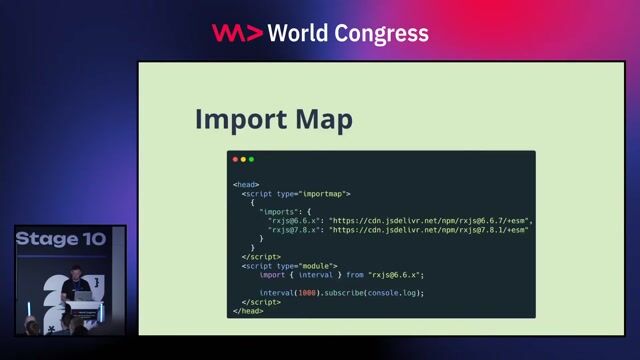
04:03 MIN
Managing dependencies with Webpack's Module Federation
The Dependency Cookbook - Recipes for Micro Frontend success
Featured Partners
Related Videos
 45:40
45:40Micro Frontends with Module Federation: Why and How?
Manfred Steyer
 33:18
33:18The Microfrontend Revolution- Using Webpack 5 Module Federation with Angular
Manfred Steyer
 35:17
35:17Front-End Micro Apps
Serg Hospodarets
 40:05
40:05Stairway to Heaven - Scaling Frontends the Right Way
Florian Rappl
 41:49
41:49Destructuring Frontend monoliths with MicroFrontends
Trishul Goel
 43:20
43:20Microfrontends at Scale
Josh Goldberg
 47:05
47:05Micro-frontends anti-patterns
Luca Mezzalira
 29:36
29:36Native Federation: The Future of Micro Frontends and Plugin-Systems in Angular
Manfred Steyer
Related Articles
View all articles



From learning to earning
Jobs that call for the skills explored in this talk.


&why GmbH
Berlin, Germany
€50-70K
Junior
Intermediate
Senior
React
Next.js
TypeScript


PiNCAMP GmbH
Berlin, Germany
Senior
React
GraphQL
Next.js


BPCS Consulting Services GmbH
München, Germany
€70-85K
Intermediate
React
Vue.js
TypeScript


Frontier Resourcing
Manchester, United Kingdom
£50-80K
GIT
React
Vue.js
Node.js
+4
Westhouse Consulting GmbH
Mainz, Germany
Intermediate
ETL
JIRA
Scrum
Redis
React
+9
Frontier Resourcing
Cardiff, United Kingdom
£50-80K
GIT
React
Vue.js
Node.js
+4
byte5 digital media GmbH
Frankfurt am Main, Germany
Remote
Junior
CSS
HTML
React
Figma
+5
Westhouse Consulting GmbH
Frankfurt am Main, Germany
Junior
JIRA
SASS
Scrum
React
DevOps
+6