Manfred Steyer
Advanced Micro Frontends: Multi-Version and Multi-Framework Scenarios
#1about 2 minutes
Understanding micro frontends and team autonomy
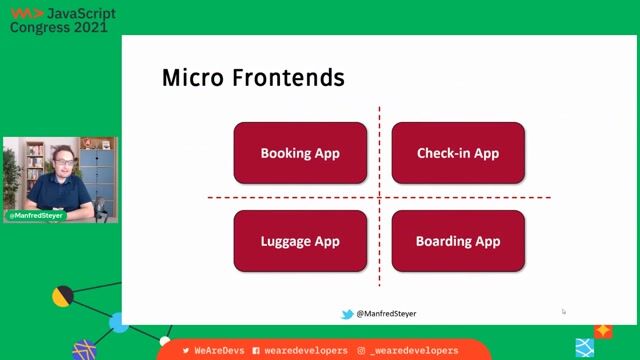
Micro frontends split a large application into independent parts to give teams autonomy and restore the agility of a small team.
#2about 3 minutes
Integrating micro frontends with module federation
Module federation enables a shell application to dynamically load remote micro frontends at runtime and share common library dependencies.
#3about 3 minutes
Navigating multi-version and multi-framework challenges
Independent teams, company mergers, or gradual migrations can lead to multiple framework versions, which may cause conflicts due to private API dependencies.
#4about 5 minutes
Using web components to abstract framework details
Wrapping micro frontends in web components creates a standardized, framework-agnostic abstraction layer for easier integration.
#5about 3 minutes
Loading abstracted components with module federation
Exposing web components via module federation allows the shell to dynamically load them while sharing dependencies when versions match or loading new versions on demand.
#6about 4 minutes
Demonstrating a multi-version and multi-framework app
A live demonstration shows an application integrating different versions of Angular, React, Vue, and AngularJS, highlighting challenges like nested routing.
#7about 2 minutes
Considering alternatives to micro frontends
Alternative architectures like monoliths, monorepos, or using iframes involve trade-offs between team autonomy and managing version complexity.
#8about 2 minutes
Understanding the organizational cost of this architecture
Adopting a micro frontend architecture requires a dedicated platform team to provide guidelines, helper functions, and workarounds for stream-aligned teams.
#9about 2 minutes
Key takeaways for building multi-version frontends
The solution combines web components for abstraction, federation for dynamic loading, and a platform team for support to successfully manage multi-version architectures.
Related jobs
Jobs that call for the skills explored in this talk.

Hubert Burda Media
München, Germany
€80-95K
Intermediate
Senior
JavaScript
Node.js
+1

Matching moments
04:34 MIN
Conclusion and key takeaways on micro frontends
Micro Frontends with Module Federation: Why and How?
05:24 MIN
The role of micro-frontends in scaling development teams
Micro-Frontends with Module Federation: Beyond the Basics
13:10 MIN
Audience Q&A on practical micro-frontend challenges
Micro-frontends anti-patterns
02:47 MIN
The primary reasons for adopting micro frontends
Micro Frontends with Module Federation: Why and How?
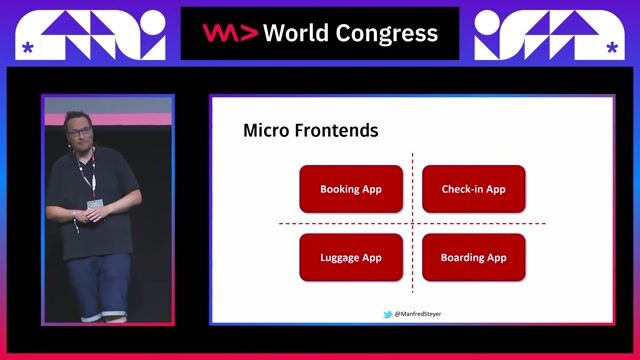
02:27 MIN
Understanding the core challenge of micro frontend integration
Native Federation: The Future of Micro Frontends and Plugin-Systems in Angular
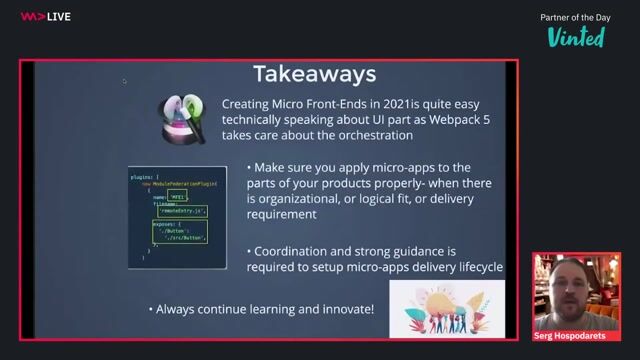
02:17 MIN
Key takeaways for adopting micro-frontends
Front-End Micro Apps
04:06 MIN
The historical challenge of building micro frontends
The Microfrontend Revolution- Using Webpack 5 Module Federation with Angular
02:54 MIN
Avoiding the multi-framework trap in micro-frontends
Micro-frontends anti-patterns
Featured Partners
Related Videos
 45:40
45:40Micro Frontends with Module Federation: Why and How?
Manfred Steyer
 29:36
29:36Native Federation: The Future of Micro Frontends and Plugin-Systems in Angular
Manfred Steyer
 44:35
44:35Micro-Frontends with Module Federation: Beyond the Basics
Manfred Steyer
 33:18
33:18The Microfrontend Revolution- Using Webpack 5 Module Federation with Angular
Manfred Steyer
 54:39
54:39Interface Contracts in Microfrontend Architectures
Alexander Günsche
 59:03
59:03Multiple Ships to the Island - Micro Frontends & Island Architectures
Florian Rappl
 21:06
21:06The Dependency Cookbook - Recipes for Micro Frontend success
Lucas Braeschke & Stefan Bley
 32:17
32:17Web-Fragments: incremental micro-frontends migration approach for enterprise
Igor Minar & Natalia Venditto
Related Articles
View all articles


.gif?w=240&auto=compress,format)
From learning to earning
Jobs that call for the skills explored in this talk.


&why GmbH
Berlin, Germany
€50-70K
Junior
Intermediate
Senior
React
Next.js
TypeScript


BPCS Consulting Services GmbH
München, Germany
€70-85K
Intermediate
React
Vue.js
TypeScript


PiNCAMP GmbH
Berlin, Germany
Senior
React
GraphQL
Next.js


ACONEXT Stuttgart GmbH
Frankfurt am Main, Germany
Remote
Senior
CSS
GIT
HTML
JSON
+13
Accso - Accelerated Solutions GmbH
Köln, Germany
Remote
Senior
Java
Scrum
React
Python
+4