Miško Hevery
Interactive server side components
#1about 2 minutes
The web performance problem with modern frameworks
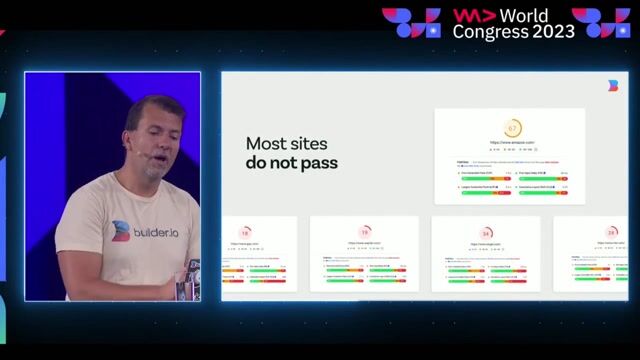
Most e-commerce websites struggle with poor Google PageSpeed scores because current frameworks prioritize runtime performance over time-to-interactive.
#2about 4 minutes
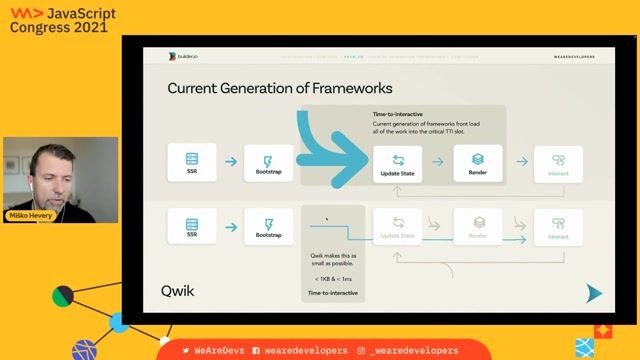
How replayable frameworks cause slow startup times
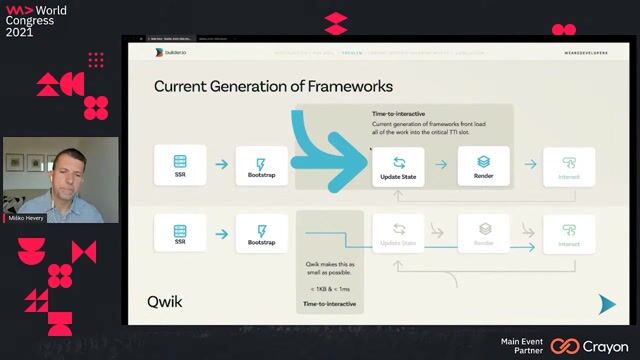
Traditional frameworks must download and execute the entire application's JavaScript on the client to "replay" the server's work and attach event listeners.
#3about 2 minutes
Qwik's resumable approach for instant interactivity
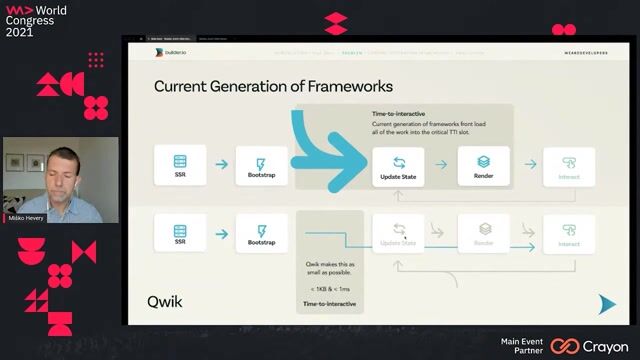
Qwik achieves near-instant interactivity by serializing application state and listeners into the HTML, allowing the client to "resume" execution with a tiny 1KB loader.
#4about 7 minutes
Comparing hydration models: monolithic, islands, and Qwik
A visual comparison shows how Qwik's fine-grained, out-of-order component hydration is more efficient than monolithic hydration or the island architecture popularized by Astro.
#5about 4 minutes
Live demo of a Qwik to-do application
A to-do app demonstrates how Qwik downloads only a tiny loader initially, then fetches small JavaScript chunks on demand as the user interacts with the UI.
#6about 4 minutes
How the Qwik optimizer automates code splitting
The Qwik optimizer automatically creates lazy-loading boundaries using `Q hook` markers, eliminating the need for developers to manually configure code splitting.
#7about 7 minutes
Serializing component relationships for fine-grained reactivity
Qwik serializes component state and relationships directly into the HTML, enabling the client to perform targeted updates without downloading or executing the entire application.
#8about 4 minutes
Q&A on web components, SEO, and state management
The discussion covers the theoretical integration with web components and Shadow DOM, the positive SEO impact of serving pure HTML, and compatibility with state libraries like Redux.
#9about 8 minutes
Q&A on performance, architecture, and PWA capabilities
Questions are answered regarding HTTP request overhead, using Qwik as a full framework replacement, managing HTML size, and leveraging resumability for PWA offline state.
#10about 3 minutes
Q&A on integration, debugging, and dependencies
The final questions address the process of integrating Qwik into existing projects, debugging via DOM attributes, and the framework's ability to handle circular dependencies.
Related jobs
Jobs that call for the skills explored in this talk.

Hubert Burda Media
München, Germany
€80-95K
Intermediate
Senior
JavaScript
Node.js
+1


tree-IT GmbH
Bad Neustadt an der Saale, Germany
€54-80K
Intermediate
Senior
Java
TypeScript
+1
Matching moments
01:35 MIN
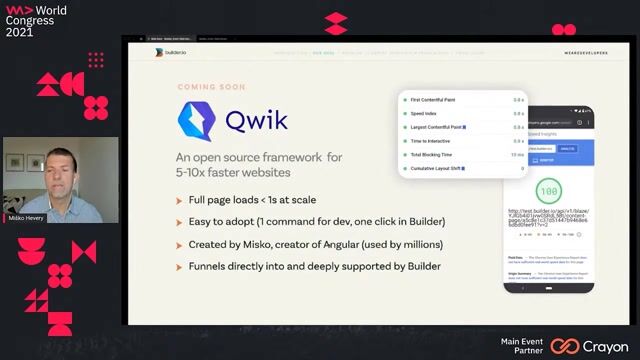
Introducing Qwik for instant time to interactive
Rethinking web application design for fastest possible time to interactive
04:05 MIN
Demonstrating lazy loading and execution with Qwik
Qwik: Making sure that easy is same as performant
05:57 MIN
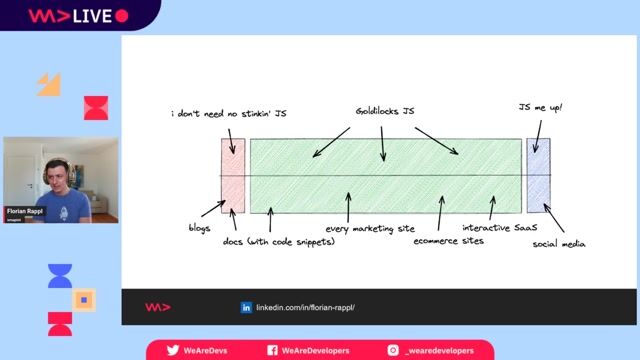
Introducing islands architecture to reduce javascript payload
Multiple Ships to the Island - Micro Frontends & Island Architectures
02:29 MIN
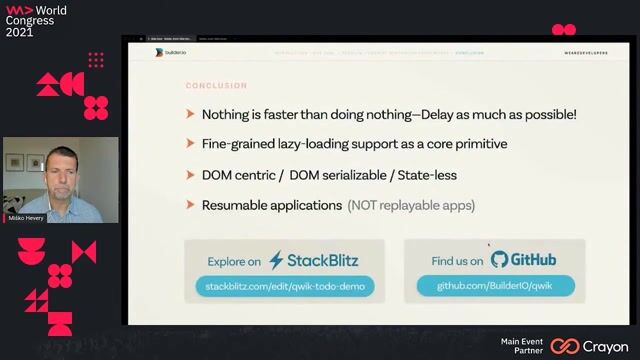
Conclusion and key takeaways for building fast apps
Rethinking web application design for fastest possible time to interactive
02:15 MIN
How Qwik bypasses hydration with resumability
Rethinking web application design for fastest possible time to interactive
02:08 MIN
Demonstrating Qwik's minimal JavaScript footprint
Rethinking web application design for fastest possible time to interactive
08:02 MIN
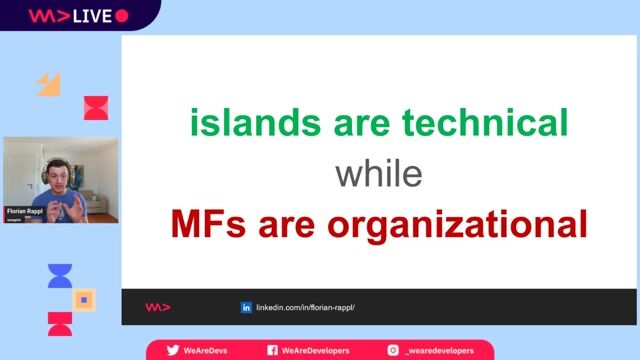
Combining micro frontends with an islands architecture
Multiple Ships to the Island - Micro Frontends & Island Architectures
05:00 MIN
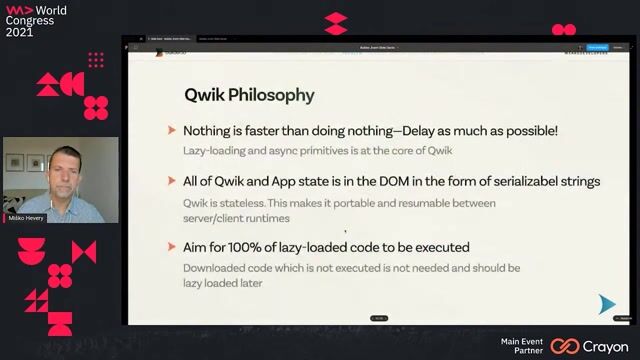
The philosophy of doing nothing and fine-grained lazy loading
Rethinking web application design for fastest possible time to interactive
Featured Partners
Related Videos
 44:35
44:35Rethinking web application design for fastest possible time to interactive
Misko Hevery
 26:00
26:00To New Frontiers: The Future of Frontend Development
Rainer Hahnekamp
 30:59
30:59Qwik: Making sure that easy is same as performant
Miško Hevery
 43:20
43:20Microfrontends at Scale
Josh Goldberg
 46:46
46:46The Lean Web
Chris Ferdinandi
 40:24
40:24Snappy UI needs no Single-Page Application
Clemens Helm
 29:04
29:04Why HTMX is crushing React, Vue & Svelte.
Felix Eckhardt & Benedikt Stemmildt
 59:03
59:03Multiple Ships to the Island - Micro Frontends & Island Architectures
Florian Rappl
Related Articles
View all articles



From learning to earning
Jobs that call for the skills explored in this talk.


&why GmbH
Berlin, Germany
€50-70K
Junior
Intermediate
Senior
React
Next.js
TypeScript


Qualysoft
Vienna, Austria
Remote
€62-104K
RxJS
Figma
Angular
+1