Matthias Falkenberg & Timo Knapp
Back(end) to the Future: Embracing the continuous Evolution of Infrastructure and Code
#1about 3 minutes
Consolidating multiple apps into a single experience
The My Porsche app evolved from many individual applications into a unified experience by introducing a backend-for-frontend to abstract legacy systems.
#2about 5 minutes
Moving from blocking to non-blocking with Spring WebFlux
The backend evolved from the thread-per-request model of Spring Web MVC to the event-driven, non-blocking model of Spring WebFlux for improved scalability.
#3about 2 minutes
Using Kotlin Coroutines to simplify complex reactive code
Kotlin Coroutines were adopted with WebFlux to handle complex business logic using a familiar imperative style, avoiding the complexities of nested declarative chains.
#4about 5 minutes
Migrating incrementally with the WebFlux sandwich pattern
The "WebFlux sandwich" pattern enables a gradual migration by refactoring the core business logic to coroutines first while bridging to existing Reactor-based controllers and clients.
#5about 3 minutes
Comparing the performance and scalability of different approaches
A performance analysis shows that while the mixed migration approach has a temporary throughput dip, it enables a path to the highly scalable pure Kotlin Coroutines implementation.
#6about 3 minutes
Identifying the limitations of the initial Cloud Foundry platform
The original Cloud Foundry infrastructure presented challenges with limited configuration control, restricted logging, and scaling quotas, necessitating a migration to a new platform.
#7about 6 minutes
Evaluating Azure compute options for a new platform
A systematic evaluation of Azure services like VMs, AKS, and App Service against key requirements led to the selection of a suitable new platform for the backend.
#8about 3 minutes
Understanding the features of Azure Container Apps
Azure Container Apps is a serverless container platform built on Kubernetes that integrates open-source tools like KEDA for event-driven scaling and Dapr for simplified microservice communication.
#9about 3 minutes
Implementing the new architecture on Azure Container Apps
The new architecture uses an Application Gateway, a vNet with multiple subnets, and Dapr sidecars for service communication, all provisioned automatically using Bicep templates.
#10about 4 minutes
Navigating pitfalls during the Azure Container Apps migration
The migration involved challenges such as breaking changes in the preview service, strict vNet requirements, and debugging unexpected behavior in Dapr's request handling.
#11about 1 minute
Future plans for evolving the application and infrastructure
The team plans to complete the coroutine migration, implement bidirectional communication, and further leverage Dapr and KEDA for enhanced resilience and scaling.
Related jobs
Jobs that call for the skills explored in this talk.


Wilken GmbH
Ulm, Germany
Senior
Amazon Web Services (AWS)
Kubernetes
+1

envelio
Köln, Germany
Remote
Senior
Python
Software Architecture
Matching moments
02:55 MIN
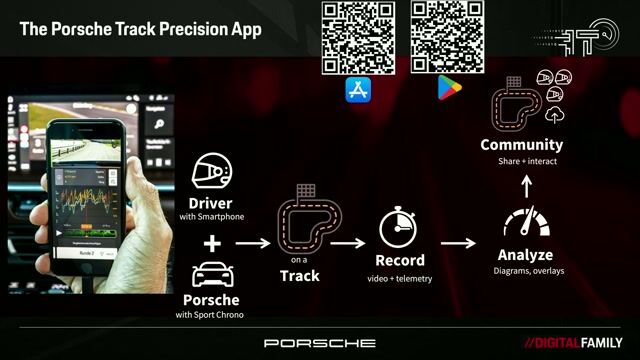
Backend architecture of the Track Precision App
Car's are Technology on Wheels - Impact of Software and IT Competence in Automotive

03:07 MIN
Challenges of modernizing and scaling monolithic frontends
Web-Fragments: incremental micro-frontends migration approach for enterprise
01:03 MIN
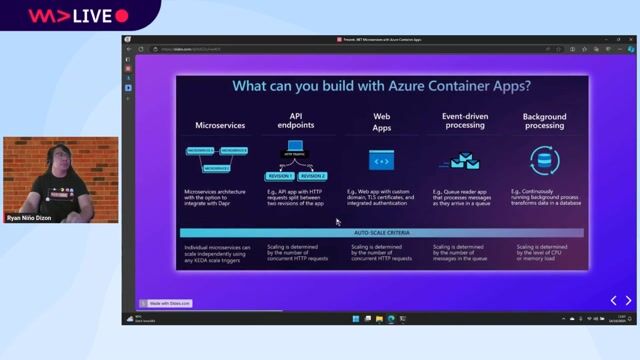
Exploring common use cases for Azure Container Apps
.NET Microservices in Azure Container Apps
04:39 MIN
Separating the frontend and migrating to open source
Application Modernization and Rabbits
04:26 MIN
The evolution of Spring Boot and container technologies
What's (new) with Spring Boot and Containers?
04:25 MIN
The challenge of building scalable frontend applications
Typescript, React and Atomic Design - a match made in heaven
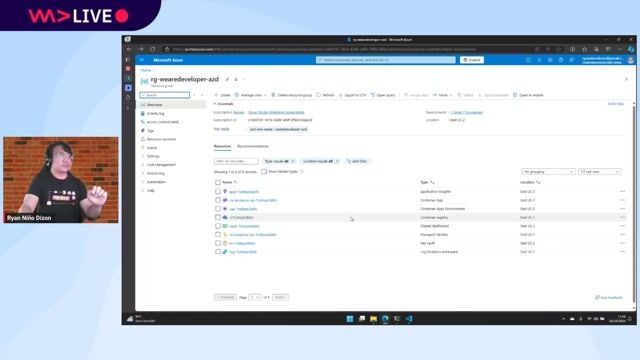
05:00 MIN
Managing frontend and backend microservices communication
.NET Microservices in Azure Container Apps
05:12 MIN
Fostering a modern engineering culture at scale
Inside Mercedes-Benz: How CIO Katrin Lehmann is Empowering 5,000 Developers and Driving Digital Change
Featured Partners
Related Videos
 52:24
52:24Slip Through the Boundaries of Legacy Systems with Kotlin and Spring WebFlux
Lukas Georgieff & Alberto Gisbert
 43:26
43:26Develop enterprise-ready applications for Microsoft Teams with Azure resources on modern web technologies
Markus Möller
 32:42
32:42.NET Microservices in Azure Container Apps
Ryan Niño Dizon
 44:09
44:09Mobile at a Crossroads: The Declarative UI App Revolution
Peter Steinberger
 29:26
29:26Empowering Thousands of Developers: Our Journey to an Internal Developer Platform
Bastian Heilemann & Bruno Margula
 24:47
24:47Advanced Micro Frontends: Multi-Version and Multi-Framework Scenarios
Manfred Steyer
 54:39
54:39Interface Contracts in Microfrontend Architectures
Alexander Günsche
 51:04
51:04Meet Your New BFF: Backend to Frontend without the Duct Tape
Noam Honig
Related Articles
View all articles



From learning to earning
Jobs that call for the skills explored in this talk.


&why GmbH
Berlin, Germany
€50-70K
Junior
Intermediate
Senior
React
Next.js
TypeScript


BPCS Consulting Services GmbH
München, Germany
€70-85K
Intermediate
React
Vue.js
TypeScript


Albert Heijn
Zaandam, Netherlands
€6K
Intermediate
API
Java
Azure
Kafka
+6
mund consulting AG
Java
Azure
DevOps
Gitlab
Jenkins
+1
Workbuddy
Eindhoven, Netherlands
Remote
€3-6K
Intermediate
API
.NET
REST
+13
Skalbach Gmbh
Kornwestheim, Germany
API
.NET
Doka GmbH
Amstetten, Austria
Remote
€49K
.NET
Azure
React
+3