
Luca Mezzalira
Micro-frontends anti-patterns
#1about 3 minutes
A brief history of the micro-frontend architectural pattern
The evolution of micro-frontends is traced from early implementations like Zalando's Taylor.js to its recognition by ThoughtWorks and InfoQ.
#2about 3 minutes
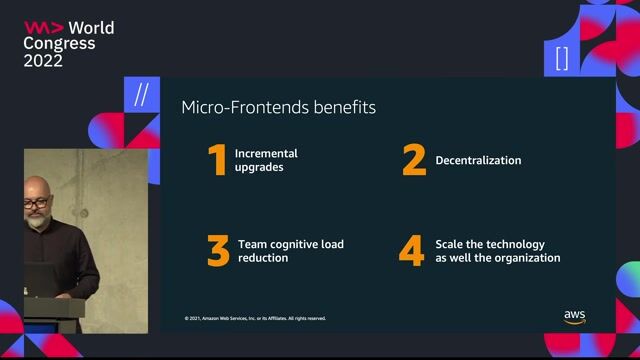
Understanding the key benefits of micro-frontend architecture
Micro-frontends enable incremental upgrades, decentralized decision-making, and reduced team cognitive load by aligning architecture with organizational structure.
#3about 4 minutes
Differentiating between domain-aware micro-frontends and components
A micro-frontend represents a business subdomain and is independent, whereas a component is a reusable UI element configured by its container.
#4about 3 minutes
Avoiding the multi-framework trap in micro-frontends
Using multiple UI frameworks should be a temporary strategy for specific scenarios like legacy migration or company acquisitions, not a default choice.
#5about 4 minutes
Using an anti-corruption layer for legacy system integration
When integrating a legacy system, use an anti-corruption layer like an iframe to isolate it and translate its communication patterns, preventing contamination of the main application.
#6about 5 minutes
Managing the complexity and risk of shared libraries
Shared libraries create tight coupling and versioning challenges, so prefer duplication over premature abstraction and use dependency injection for necessary sharing.
#7about 3 minutes
Adopting unidirectional data flow for better debugging
Bidirectional data flow between a host and remote micro-frontend creates complexity, while a unidirectional flow simplifies debugging and reduces errors.
#8about 3 minutes
Preventing organizational coupling caused by shared global state
Sharing a global state across micro-frontends couples development teams together, so use loosely coupled communication methods like an event emitter instead.
#9about 3 minutes
Avoiding self-inflicted load by consolidating API calls
Having multiple micro-frontends call the same API endpoint creates unnecessary backend load, so consolidate these calls into a single parent micro-frontend or component.
#10about 1 minute
Recognizing that architectural decisions are context-dependent trade-offs
There are no universally right or wrong architectural choices, as the validity of a pattern depends entirely on the specific project context and organizational needs.
#11about 13 minutes
Audience Q&A on practical micro-frontend challenges
The speaker answers audience questions on topics including using iframes, splitting monoliths, designing for future scalability, and comparing composition tools.
Related jobs
Jobs that call for the skills explored in this talk.

Hubert Burda Media
München, Germany
€80-95K
Intermediate
Senior
JavaScript
Node.js
+1

Matching moments
03:57 MIN
Anti-pattern: Analyzing the backend impact of frontend architecture
Micro-frontends anti-patterns
04:52 MIN
Anti-pattern: Confusing micro-frontends with reusable components
Micro-frontends anti-patterns
04:34 MIN
Conclusion and key takeaways on micro frontends
Micro Frontends with Module Federation: Why and How?

05:13 MIN
Avoiding common pitfalls with micro-frontends
Front-End Micro Apps
08:02 MIN
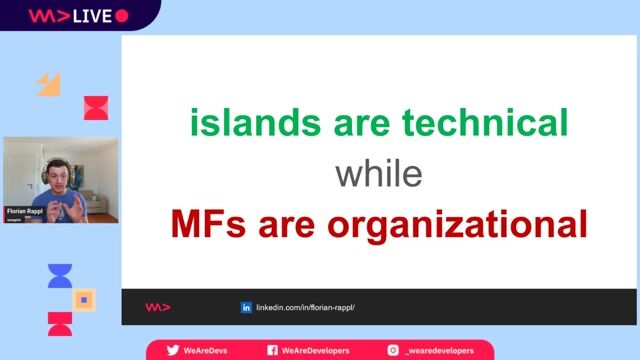
Combining micro frontends with an islands architecture
Multiple Ships to the Island - Micro Frontends & Island Architectures
02:15 MIN
The architectural evolution from monoliths to micro-frontends
Front-End Micro Apps

06:11 MIN
Tracing the architectural evolution to microfrontends
Microfrontends with Blazor: Welcome to the Party!

00:51 MIN
Knowing when not to use a micro-frontend architecture
Front-End Micro Apps
Featured Partners
Related Videos
 40:17
40:17Micro-frontends anti-patterns
Luca Mezzalira
 45:40
45:40Micro Frontends with Module Federation: Why and How?
Manfred Steyer
 43:20
43:20Microfrontends at Scale
Josh Goldberg
 59:03
59:03Multiple Ships to the Island - Micro Frontends & Island Architectures
Florian Rappl
 54:39
54:39Interface Contracts in Microfrontend Architectures
Alexander Günsche
 44:35
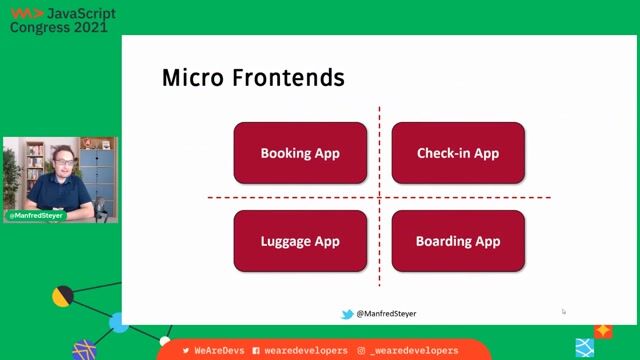
44:35Micro-Frontends with Module Federation: Beyond the Basics
Manfred Steyer
 41:49
41:49Destructuring Frontend monoliths with MicroFrontends
Trishul Goel
 28:13
28:1310 must-know design patterns for JS Devs
Erick Wendel
Related Articles
View all articles

.gif?w=240&auto=compress,format)

From learning to earning
Jobs that call for the skills explored in this talk.


&why GmbH
Berlin, Germany
€50-70K
Junior
Intermediate
Senior
React
Next.js
TypeScript


dlocal
Barcelona, Spain
Intermediate
API
React
Node.js
Next.js
Grafana
+7
Adaptive Financial Consulting
Barcelona, Spain
CSS
HTML
RxJS
React
JavaScript
+1