Luca Mezzalira
Micro-frontends anti-patterns
#1about 3 minutes
Understanding the core benefits of micro-frontend architecture
Micro-frontends enable incremental upgrades, decentralized decision-making, reduced team cognitive load, and scalable organizational structures.
#2about 5 minutes
Anti-pattern: Confusing micro-frontends with reusable components
A micro-frontend represents a business sub-domain and is independently deployable, whereas a component has its behavior dictated by its container.
#3about 2 minutes
Anti-pattern: Using a multi-framework approach incorrectly
While technically possible, using multiple frameworks should be reserved for temporary situations like migrating legacy systems, not for developer preference.
#4about 5 minutes
Anti-pattern: Using an anti-corruption layer for legacy systems
Instead of adding complex, one-off logic to the main application shell, wrap legacy code in a dedicated micro-frontend that acts as an anti-corruption layer.
#5about 4 minutes
Anti-pattern: The risks of shared core libraries
Creating shared core libraries can lead to versioning conflicts and deployment coupling, so prefer composition over inheritance to minimize these risks.
#6about 3 minutes
Anti-pattern: Adopting unidirectional data flow for easier debugging
Bi-directional data sharing between a host and micro-frontends creates complexity, while unidirectional data flow patterns like Flux make state changes predictable.
#7about 2 minutes
Anti-pattern: Avoiding tight coupling with event-based communication
Using a shared global state creates tight design-time coupling between teams; a publish-subscribe (pub/sub) event system enables loosely coupled communication.
#8about 4 minutes
Anti-pattern: Analyzing the backend impact of frontend architecture
When multiple micro-frontends call the same API, it may indicate overlapping domains and cause unnecessary backend load, so consider merging them or using components.
#9about 4 minutes
Viewing software architecture as a series of trade-offs
Architectural decisions are not right or wrong but are based on context-specific trade-offs that should be documented using tools like Architectural Decision Records (ADRs).
#10about 8 minutes
Q&A: MFE communication, monorepos, and appropriate use cases
The discussion covers preferred methods for MFE-to-MFE communication, the trade-offs between monorepos and multi-repos, and when micro-frontends are an appropriate choice.
Related jobs
Jobs that call for the skills explored in this talk.

Hubert Burda Media
München, Germany
€80-95K
Intermediate
Senior
JavaScript
Node.js
+1

Matching moments
03:17 MIN
A brief history of the micro-frontend architectural pattern
Micro-frontends anti-patterns
02:03 MIN
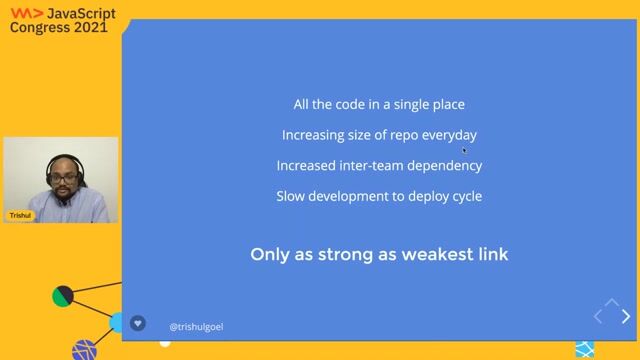
Introducing the micro-frontend architectural pattern
Destructuring Frontend monoliths with MicroFrontends
03:02 MIN
Understanding the key benefits of micro-frontend architecture
Micro-frontends anti-patterns
02:17 MIN
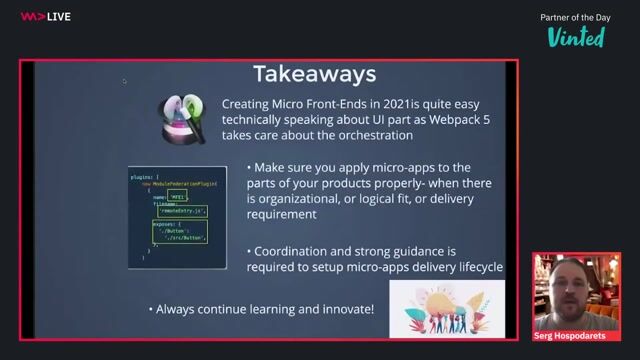
Key takeaways for adopting micro-frontends
Front-End Micro Apps
02:15 MIN
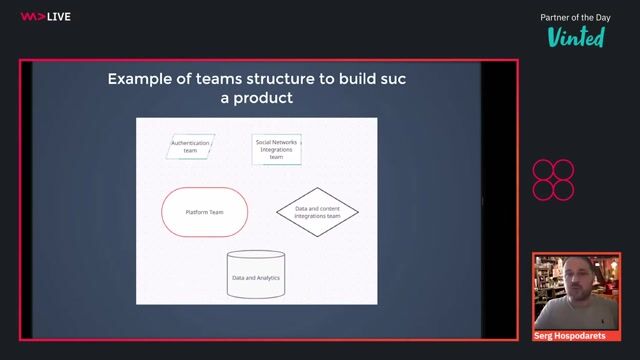
The architectural evolution from monoliths to micro-frontends
Front-End Micro Apps

01:49 MIN
Micro frontends are an organizational pattern for scaling teams
Multiple Ships to the Island - Micro Frontends & Island Architectures
04:34 MIN
Conclusion and key takeaways on micro frontends
Micro Frontends with Module Federation: Why and How?

00:51 MIN
Knowing when not to use a micro-frontend architecture
Front-End Micro Apps
Featured Partners
Related Videos
 47:05
47:05Micro-frontends anti-patterns
Luca Mezzalira
 45:40
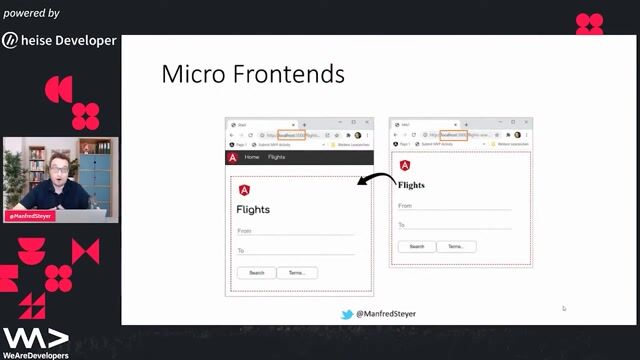
45:40Micro Frontends with Module Federation: Why and How?
Manfred Steyer
 43:20
43:20Microfrontends at Scale
Josh Goldberg
 59:03
59:03Multiple Ships to the Island - Micro Frontends & Island Architectures
Florian Rappl
 54:39
54:39Interface Contracts in Microfrontend Architectures
Alexander Günsche
 40:05
40:05Stairway to Heaven - Scaling Frontends the Right Way
Florian Rappl
 44:35
44:35Micro-Frontends with Module Federation: Beyond the Basics
Manfred Steyer
 41:49
41:49Destructuring Frontend monoliths with MicroFrontends
Trishul Goel
Related Articles
View all articles
.gif?w=240&auto=compress,format)


From learning to earning
Jobs that call for the skills explored in this talk.


&why GmbH
Berlin, Germany
€50-70K
Junior
Intermediate
Senior
React
Next.js
TypeScript


dlocal
Barcelona, Spain
Intermediate
API
React
Node.js
Next.js
Grafana
+7
Adaptive Financial Consulting
Barcelona, Spain
CSS
HTML
RxJS
React
JavaScript
+1
adesso SE
Koblenz, Germany
Remote
React
Vue.js
Angular
JavaScript
Companyat Audienceproject
Charing Cross, United Kingdom
Remote
£100-120K
Senior
CSS
HTML
React
+10